


Page 153 - (DK) Help Your Kids with Growing Up: A No-Nonsense Guide to Puberty and Adolescence
P. 153
BULLY ING      151

        Tackling bullying                                  Impact of bullying
        Bullying can seem like a difficult situation to resolve,    Being bullied can affect every aspect of a young person’s life.
        but it’s important to take action as everybody will    It can disrupt their ability to sleep, enjoy activities, or study,
        suffer if it continues.                            and have an impact on their physical health. Their mental
                                                           health might suffer as bullying can lead to low self-esteem,
                                                           anxiety, feelings of anger or aggression, and depression.
          If you’re being bullied
          • Try not to react to the bully in the way they anticipate or get
           angry, as they may lose interest.                 P ARENT  TIPS
          • Block bullies online or on your phone and keep any abusive   Seeing the signs
           messages as a record.
                                                             It can be hard to know if your teen is being bullied as they
          • Tell a trusted adult what is happening, or contact a support   may not want to tell you. The following signs may indicate
           group if you feel you can’t talk to your parents or teacher.
                                                             a problem:
                                                             • sudden reluctance to do activities they previously enjoyed
                                                             • unexplained changes in behaviour, such as becoming
          If you’re trying to help someone who                withdrawn or preoccupied
          is being bullied                                   • coming home with bruises, or without certain belongings
                                                             • anxiety about going to school or complaining about feeling
          • Don’t watch or join in with the bullying as this may   too ill to go to school when they are well
           encourage the bullies.
          • Stand up for the person as long as you feel it is safe to do so.
          • Advise the person being bullied to tell, or help them to tell,
           an adult they trust. Tell an adult yourself if they are unable to.
                                                           Getting help
                                                           A teen may find it difficult to admit they are being bullied, but
                                                           acknowledging the problem is the first step towards resolving
          If you’re the bully                              it. It’s important for a teen to call on their friends for emotional
                                                           support, and to talk to a trusted adult who can take action to
          • Apologize to the people you have bullied and try    improve the situation.
           to make amends.
          • Ask a trusted adult to help you resolve any difficult feelings
           or situations you might be struggling with.
          • Forgive yourself, learn from your behaviour, and move on.


          If you’re the parent of a bully
          • Bullies often resort to bullying because they feel insecure,
           fearful, or unable to cope. Sometimes they’re being bullied
           themselves. Try to find out why they’ve behaved in this way.
          • Encourage your teen to apologize and to try to
           make amends.
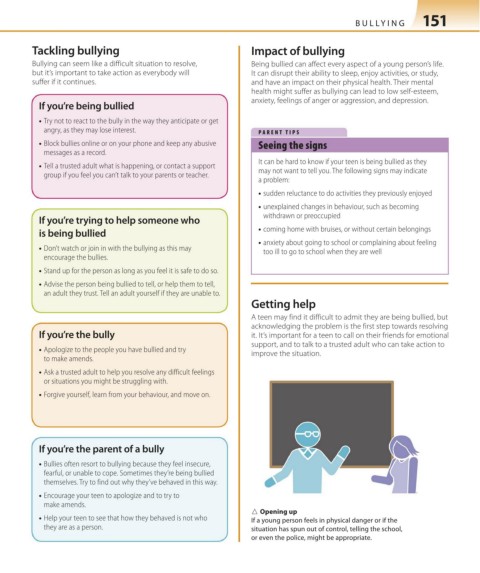
                                                           △ Opening up
          • Help your teen to see that how they behaved is not who   If a young person feels in physical danger or if the
           they are as a person.                           situation has spun out of control, telling the school,
                                                           or even the police, might be appropriate.


   150-151_Bullying.indd   151                                                                       24/03/2017   17:18

