


Page 167 - (DK) Help Your Kids with Growing Up: A No-Nonsense Guide to Puberty and Adolescence
P. 167
SMOKING 1        6 5
                                                                                                  165

        Passive smoking
        Passive, or second-hand, smoking occurs when a person
        inhales smoke in the air, emitted from a burning cigarette
        or exhaled smoke. Prolonged exposure of non-smokers to
        second-hand smoke increases their risk of cancer, heart and
        lung disease, respiratory problems, and premature death.


        ▷ Second-hand smoke
        There is no known safe level of exposure to second-hand
        smoke, and it’s especially harmful to young children.


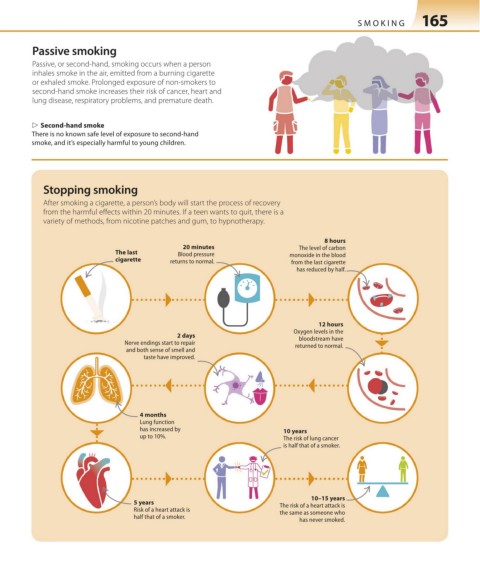
           Stopping smoking
           After smoking a cigarette, a person’s body will start the process of recovery
           from the harmful effects within 20 minutes. If a teen wants to quit, there is a
           variety of methods, from nicotine patches and gum, to hypnotherapy.

                                                                            8 hours
                                           20 minutes                 The level of carbon
                            The last      Blood pressure            monoxide in the blood
                            cigarette   returns to normal.          from the last cigarette
                                                                     has reduced by half.


                                                                          12 hours
                                                                     Oxygen levels in the
                                          2 days
                                                                      bloodstream have
                              Nerve endings start to repair          returned to normal.
                              and both sense of smell and
                                  taste have improved.


                                 4 months
                                 Lung function
                                 has increased by                 10 years
                                 up to 10%.                       The risk of lung cancer
                                                                  is half that of a smoker.


                                                                         10–15 years
                                5 years                          The risk of a heart attack is
                                Risk of a heart attack is        the same as someone who
                                half that of a smoker.
                                                                      has never smoked.


   164-165_Smoking.indd   165                                                                        24/03/2017   17:19

