


Page 227 - (DK) Help Your Kids with Growing Up: A No-Nonsense Guide to Puberty and Adolescence
P. 227
SEX 225


          Oral sex                                         Anal sex
          When someone uses their mouth or tongue to stimulate   Any sexual activity involving the anus is known as anal
          their partner’s genitals, the act is known as oral sex. This   sex. This can be a type of sex, or a part of foreplay, for all
          can be a type of sex, or a part of foreplay, for all kinds of   kinds of partners. It’s important to agree that it’s what
          partners. Not everyone finds oral sex pleasurable, or   both partners want. Some people don’t want to have
          wants to do it. It depends on the preferences of both    anal sex, but some people enjoy it, and experience
          the person giving and the person receiving the   orgasm during it. It’s important not to have vaginal sex
          stimulation. Some people enjoy it, and many partners   after anal sex without washing the penis or replacing
          experience orgasm during it.                     a condom.


        Open conversations
        Talking about sex can be embarrassing for everyone, but it’s better
        teens find out the facts from their parents, rather than discovering
        incorrect information through friends or on the Internet. Some parents
        worry that talking about sex will encourage their teen to have sex, but there
        is no evidence to support this. In fact, open discussions are proven to reduce
        the occurrence of STIs and lower the rates of teen pregnancy.

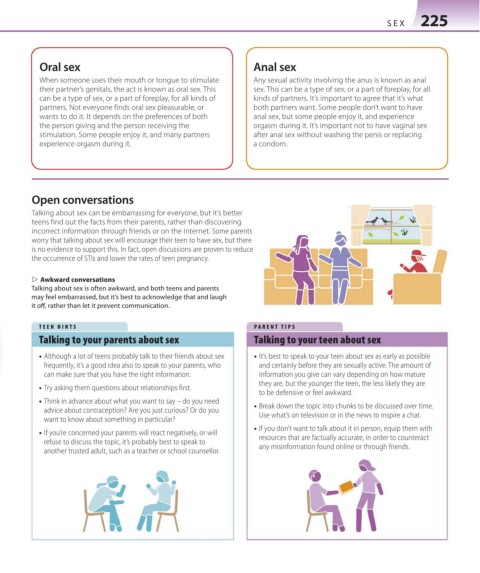
        ▷ Awkward conversations
        Talking about sex is often awkward, and both teens and parents
        may feel embarrassed, but it’s best to acknowledge that and laugh
        it off, rather than let it prevent communication.

          TEEN  HINTS                                       P ARENT  TIPS
          Talking to your parents about sex                 Talking to your teen about sex

          • Although a lot of teens probably talk to their friends about sex   • It’s best to speak to your teen about sex as early as possible
           frequently, it’s a good idea also to speak to your parents, who   and certainly before they are sexually active. The amount of
           can make sure that you have the right information.   information you give can vary depending on how mature
                                                             they are, but the younger the teen, the less likely they are
          • Try asking them questions about relationships first.
                                                             to be defensive or feel awkward.
          • Think in advance about what you want to say – do you need
           advice about contraception? Are you just curious? Or do you   • Break down the topic into chunks to be discussed over time.
                                                             Use what’s on television or in the news to inspire a chat.
           want to know about something in particular?
                                                            • If you don’t want to talk about it in person, equip them with
          • If you’re concerned your parents will react negatively, or will   resources that are factually accurate, in order to counteract
           refuse to discuss the topic, it’s probably best to speak to
           another trusted adult, such as a teacher or school counsellor.  any misinformation found online or through friends.


   224-225_299754_HYKWGU_Sex.indd   225                                                              24/03/2017   17:50

