


Page 231 - (DK) Help Your Kids with Growing Up: A No-Nonsense Guide to Puberty and Adolescence
P. 231
SEXU AL  REPRODUC TION          229


          GOOD  T O  KNO W
          Assisted conception

          Some couples who want to have children don’t find it easy to become pregnant.
          Becoming pregnant is known as conception, and not conceiving is known as “infertility”.
          Infertility can have many causes, and many different treatments, too. Some females
          don’t produce eggs regularly, but this can often be treated by stimulating the ovaries
          with drugs. In other cases, the fallopian tubes may be blocked, which stops the sperm
          and egg from coming together, but this can be treated with delicate surgery, as can
          other problems in the uterus. Some males don’t produce many sperm, and there are a
          variety of ways to treat this.
          In vitro fertilization (IVF) is a medical method often used to help couples who can’t
          conceive naturally. This involves collecting eggs from the ovaries and mixing them with
          sperm “in vitro” (in glassware or a laboratory dish). If fertilization occurs, the embryo can
          then be placed into the uterus, leading to a pregnancy.


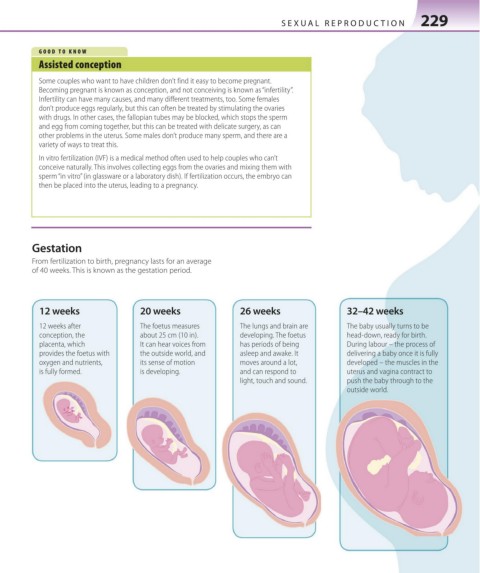
        Gestation
        From fertilization to birth, pregnancy lasts for an average
        of 40 weeks. This is known as the gestation period.


          12 weeks               20 weeks               26 weeks                 32–42 weeks
          12 weeks after         The foetus measures    The lungs and brain are   The baby usually turns to be
          conception, the        about 25 cm (10 in).    developing. The foetus   head-down, ready for birth.
          placenta, which        It can hear voices from   has periods of being   During labour – the process of
          provides the foetus with   the outside world, and   asleep and awake. It   delivering a baby once it is fully
          oxygen and nutrients,    its sense of motion    moves around a lot,    developed – the muscles in the
          is fully formed.       is developing.         and can respond to       uterus and vagina contract to
                                                        light, touch and sound.   push the baby through to the
                                                                                 outside world.


   228-229_299754_HYKWGU_Sexual_reproduction.indd   229                                              24/03/2017   17:20

