


Page 27 - (DK) Help Your Kids with Growing Up: A No-Nonsense Guide to Puberty and Adolescence
P. 27
GENDER         25

        Breaking down gender stereotypes
        Most societies encourage people to behave in a certain way, wear
        appropriate clothes, and do particular things, based on conventional
        ideas about what it means to be a woman or a man, and to be
        feminine or masculine. Unfortunately, people who do not conform
        to these expectations may encounter disapproval from society.
          Thinking more broadly about gender allows everybody to express
        themselves more fully. Gender stereotypes regularly appear in the
        media and may lead someone to feel there are things they can’t
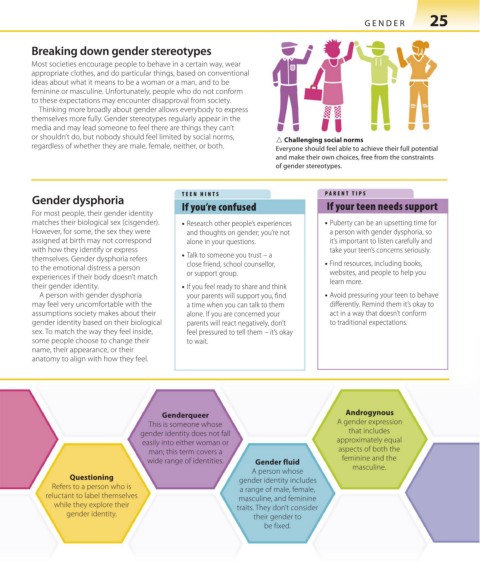
        or shouldn’t do, but nobody should feel limited by social norms,   △ Challenging social norms
        regardless of whether they are male, female, neither, or both.  Everyone should feel able to achieve their full potential
                                                                 and make their own choices, free from the constraints
                                                                 of gender stereotypes.


        Gender dysphoria                   TEEN  HINTS                      P ARENT  TIPS
                                                                             If your teen needs support
        For most people, their gender identity   If you’re confused
        matches their biological sex (cisgender).   • Research other people’s experiences   • Puberty can be an upsetting time for
        However, for some, the sex they were   and thoughts on gender; you’re not   a person with gender dysphoria, so
        assigned at birth may not correspond   alone in your questions.      it’s important to listen carefully and
        with how they identify or express                                    take your teen’s concerns seriously.
        themselves. Gender dysphoria refers    • Talk to someone you trust – a    • Find resources, including books,
        to the emotional distress a person   close friend, school counsellor,
        experiences if their body doesn’t match   or support group.          websites, and people to help you
                                                                             learn more.
        their gender identity.             • If you feel ready to share and think
          A person with gender dysphoria    your parents will support you, find    • Avoid pressuring your teen to behave
        may feel very uncomfortable with the   a time when you can talk to them   differently. Remind them it’s okay to
        assumptions society makes about their   alone. If you are concerned your   act in a way that doesn’t conform
        gender identity based on their biological   parents will react negatively, don’t    to traditional expectations.
        sex. To match the way they feel inside,   feel pressured to tell them – it’s okay
        some people choose to change their   to wait.
        name, their appearance, or their
        anatomy to align with how they feel.


                                      Genderqueer                                Androgynous
                                   This is someone whose                       A gender expression
                                 gender identity does not fall                   that includes
                                  easily into either woman or                  approximately equal
                                   man; this term covers a                     aspects of both the
                                   wide range of identities.  Gender fluid      feminine and the
                                                           A person whose         masculine.
                 Questioning                            gender identity includes
             Refers to a person who is                  a range of male, female,
           reluctant to label themselves                masculine, and feminine
             while they explore their                   traits. They don’t consider
                gender identity.                           their gender to
                                                              be fixed.


   024-025_Gender.indd   25                                                                          24/03/2017   17:15

