


Page 186 - Atlas Of The World's Strangest Animals
P. 186
186      ATLAS  OF THE WORLD’S  STRANGEST ANIMALS


           Found in fresh and brackish water, warm lakes and deep,  5m (16.4ft) long being caught in the Danube and Dniepr
           fast-flowing rivers, the wels catfish is one of Europe’s most  river systems.As recently as 2008, attacks in Lake
           recognizable fish species.                             Schlachtensee, near Berlin in Germany, were attributed to
             Unlike most fish, wels catfish don’t have scales. Instead  one such colossus.There are even reports, dating back to
           their green-brown bodies are long and slimy, with an   the 1400s, of wels catfish that were man-eaters.These tales
           elongated anal fin that stretches almost to the tail.The  are difficult to substantiate and are probably no more than
           head is large, broad and flattened with a pair of small, dark  tall tales or misidentifications.Yet, there’s no doubt that
           eyes set to either side. Inside the wide mouth are hundreds  these fish are aggressive and active predators.
           of tiny teeth.These are used to hold prey before it is   The young fry live on invertebrates.As they grow
           passed on to two sets of crushing pads located at the back  bigger, they become more ambitious and, while other fish
           of the fishes’ throat.                                 are their main prey, they’ll tackle amphibians, small aquatic
             The size of these fish varies from location to location,  mammals and waterfowl. In his TV series Animal World, the
           but they have long been the subject of myth and legend.  British biologist Jeremy Wade set out to discover if they
           Reports dating from the 1850s speak of giant catfish up to  would tackle a full-grown man.Well, he released one fish,


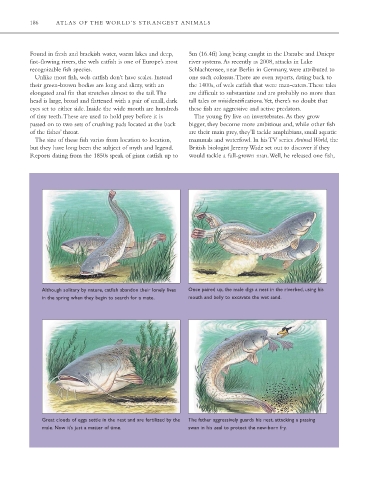
                Although solitary by nature, catfish abandon their lonely lives  Once paired up, the male digs a nest in the riverbed, using his
                in the spring when they begin to search for a mate.  mouth and belly to excavate the wet sand.


                Great clouds of eggs settle in the nest and are fertilized by the  The father aggressively guards his nest, attacking a passing
                male. Now it’s just a matter of time.             swan in his zeal to protect the new-born fry.


                                             (c) 2011 Marshall Cavendish. All Rights Reserved.

