


Page 182 - Atlas Of The World's Strangest Animals
P. 182
182      ATLAS  OF THE WORLD’S  STRANGEST ANIMALS


                                                                  was about to vanish with the advent of war. In it,Williams
             Skylark habitats
                                                                  takes his theme from the acrobatic and awe-inspiring sight
                                                                  of the male skylarks’ mating display, which is still a popular
                                                                  sight in the British countryside to this day.
                                                                    When they are on the ground, bird-watchers often refer
                                                                  to skylarks as SBJs, or ‘small brown jobs’ – a label used to
                                                                  refer to the large number of hard-to-identify little, brown
                                                                  birds that exist. It’s in the air that these SBJs transform into
                                                                  one of nature’s wonders.
                                                                    Most birds go to great lengths to keep themselves
                                                                  hidden from predators, but during the mating season
                                                                  skylarks seems to revel in danger as they wheel upwards
                                                                  through the air, singing as they ascend.The verb ‘to
                                                                  skylark’, meaning to act in a foolish or mischievous way, is
                                                                  said to come from way that these birds seem to risk life
                                                                  and limb with such a seemingly frivolous display. In reality,
                                                                  though, these acrobatics have a very serious purpose. Most
                                                                  male birds sing in order to attract a mate or to defend
                                                                  their territory and the skylarks do the same.And the song-
                                                                  flights they use to advertise their presence and availability
                                                                  to nearby females is truly spectacular.
           Ever since the composer Ralph Vaughan Williams (1872–
           1958) wrote The Lark Ascending in 1914, it has been a
           favourite with British music lovers.Williams wrote the  Dancing with death
           piece while watching troop ships head out across the   The skylarks’ performance begins with rapid wing beats as
           English Channel at the start of World War I – (1914–18).  they ascend, almost vertically into the air.After hovering
           It’s a piece that conjures up everything that the composer  for several minutes, while they sing their characteristically
           thought was quintessentially British and which he worried  melodic song, they then wheel back down to earth. Such


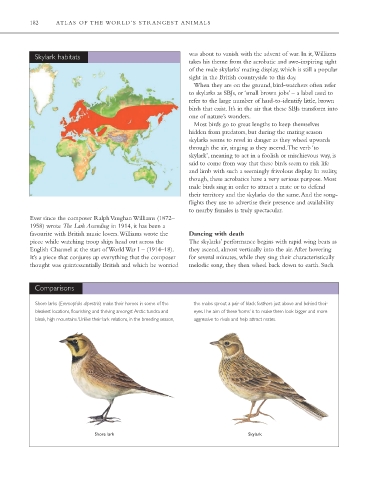
             Comparisons

             Shore larks (Eremophila alpestris) make their homes in some of the  the males sprout a pair of black feathers just above and behind their
             bleakest locations, flourishing and thriving amongst Arctic tundra and  eyes.The aim of these ‘horns’ is to make them look bigger and more
             bleak, high mountains. Unlike their lark relations, in the breeding season,  aggressive to rivals and help attract mates.


                                  Shore lark                                           Skylark


                                             (c) 2011 Marshall Cavendish. All Rights Reserved.

