


Page 141 - (DK Eyewitness) Travel Guide - Greek Islands
P. 141
THE SAMIAN CULT OF HERA
                             Hera was worshipped as the main cult of a number of Greek
                             cities, and always at out-of-town sanctuaries. Before the
                             1st millennium BC, she was venerated in the form of a
                             simple wooden board (xoana), later augmented with a
                             copper statue. The annual Heraia festival, which saw
                             the copper statue dressed in wedding finery, celebrated
                             Hera’s union with Zeus, and was accompanied by
                             concerts and athletic contests. Housed in a special shrine
                             after the 8th century, the statue of Hera was flanked
                             by a number of live peacocks and sprigs from an osier
                             tree. Both are shown on Samian coins of the Roman era,
                             stamped with the image of the richly dressed goddess.

         Boats on the pebbly   bottomless chasms is an   Mycenaean colonists, who
         beach of the lovely   anomaly. Kerketéfs acquired   brought their worship of the
          port town of Kokkári  prominence during Byzantine   Olympian deities with them.
                           times, when religious hermits     A 30-m- (98-ft-) long temple
                           occupied some of its caves.    built in the 8th century BC was
       9                   Today, two uninhabited con-  replaced in the 6th century BC
                           vents remain: 16th-century
                                               by an Ionic stone one, planned
       Votsalákia and      Evangelistrías, perched on the   by local architect Rhoikos. This
       Mount Kerketéfs     south slope, and Theotókou   collapsed during the reign of
                           (1887), tucked into a north-  Polykrates, who ordered a
       ⌂ 50 km (31 miles)
       W of Vathý   @ to   westerly valley.    grand replacement designed
       Marathókampos                           by Rhoikos’s son, Theodoros.
                                               He began the new temple in
       Sandy Votsalákia (Kámbos                525 BC, but the vast structure
       Marathokámbou) has the   0 "            was never completed.
       longest, calmest-water beach   Heraion    Most of the finds on display
       on Sámos. Overhead, domi-  ⌂ 21 km (13 miles) SW of   at the Archaeological Museum
       nating the western tip of   Vathý   § 22730 95277     in Vathý (p138) date from the
       Sámos, 1,437 m (4,715 ft)     @ Iréo   # 8am–3pm Tues–  8th to the 6th centuries BC,
       Mt Kerketéfs is the second-  Sun  ¢ Main public hols  when the sanctuary was at
       highest peak in the Aegean              the height of its prestige.
       after Fengári on Samothráki.   A fertility goddess was   Byzantine and medi eval
       On an island composed of   worshipped here from   masons removed ready-cut
       smooth sedimentary rock,    Neolithic times, though the   stone for reuse, leaving only
       this partly igneous mountain   cult only became identified   one column untouched, still
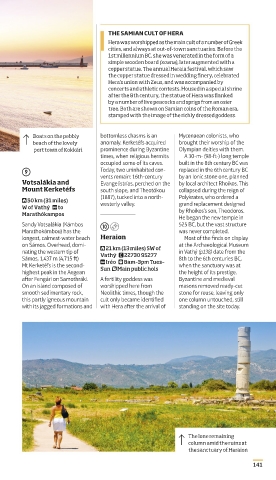
       with its jagged formations and  with Hera after the arrival of   standing on the site today.


                                                 The lone remaining
                                                 column amid the ruins at
                                                 the sanctuary of Heraion
                                                                  141


   140-141_EW_Greek_Islands.indd   141                       28/11/2018   09:52

