


Page 227 - (DK Eyewitness) Travel Guide - Greek Islands
P. 227
6 the coastal track, is a favourite A rough track leads north
with naturists. Agía Marína,
from here to remote Aténi, a
Batsí further along, has a friendly, hamlet at the head of a lush
family-run taverna. valley. Two beautiful beaches,
⌂ 8 km (5 miles) S of South of Batsí the original worth seeking out, lie further
Gávrio @
capital of Ándros, Ancient to the windy northeast, in the
Built around a sweeping Paleópoli, was inhabited until bay of Aténi. The village of
sandy bay, Batsí is a pretty around 1000 AD when the Arnás, high on the slopes of
and increasingly popular people moved to Mesariá the Kouvára mountain range,
resort. It has a small fishing (p211). It was largely destroyed has flowing springs and is one
harbour and a maze of narrow in the 4th century AD by an of the island’s greenest spots.
lanes reached by white steps earthquake, but part of the With charming dry-stone
from the café-lined seafront. acropolis is still visible, as are walls and slate bridges, this
Despite the lively nightlife, the remains of some of the is attractive walking country.
Batsí has retained its village temples under the sea.
atmosphere. The main beach Inland lies Káto Katákoilos Ancient Paleópoli
is popular with families, while village, known for its island ⌂ 9 km (6 miles) S of Batsí
Delavógias bea ch, south along music and dance festivals. # Unrestricted access
CYCLADIC ART
With their simple geometric shapes and
purity of line, Cycladic marble figurines are
the legacy of the Bronze Age civilization of
these islandsand the first real expression
of Greek art.
The figurines come from graves and are thought
to represent, or be offerings to, an ancient deity.
The earliest figures, from before 3000 BC, are
slim and violin-shaped. By 2700–2300 BC, the
forms were recognizably human and usually
female. They range from palm-sized up to life- INFLUENCE ON
sized, with the proportions remaining con sis- MODERN ART
tent. Obsidian blades, marble bowls prefiguring Cycladic art was considered ugly
later Greek art, abstract jewellery and pottery and crude when first discovered
(including the unusual “frying pans”) also in the 19th century, but the sim
survive. Excellent examples of Cycladic art plicity of its form and deco ration
can be seen in the Museum of Cycladic Art exerted a strong influence on
in Athens (p294); Cycladic artifacts are also several 20thcentury artists
found in museums throughout the world. and sculptors. These included
Picasso, Modigliani, Constantin
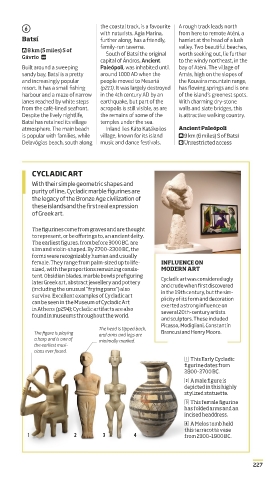
The head is tipped back,
The figure is playing and arms and legs are Brancusi and Henry Moore.
a harp and is one of minimally marked.
the earliest musi
cians ever found.
1 This Early Cycladic
figurine dates from
2800–2700 BC.
2 A male figure is
depicted in this highly
stylized statuette.
3 This female figurine
has folded arms and an
incised headdress.
4 A Melos tomb held
this terracotta vase
1 2 3 4 from 2300–1900 BC.
227
227
226-227_EW_Greek_Islands.indd 227 28/11/2018 12:55

