


Page 237 - (DK Eyewitness) Travel Guide - Greek Islands
P. 237
in his book Report to Greco                Pátmos,
       (1961). The Archaeological   0 km  5  N    Donoússa
       Museum is now housed in the   0 miles  5
       building, and has a notable           Moní Kímisi
                                              Theotókou
       collection of Cycladic marble                Agiá  Apóllonas
       figurines, as well as some   Sýros,  Abrám Beach
       beautiful Roman mosaics.  Mýkonos, Páros  Moní        Náxo s
         The lagoon-like bay of Ágios   Faneroménis  Koronída
       Geórgios, to the south, is Náxos                       Liónas
       town’s main resort area, with   Galíni       Kóronos
       golden sands and shallow            Mélanes
                                            Valley
       water. The best beaches are   Náxos Town   Kinídaros
       out of town, along the west   Ágios Geórgios  Kouroúnohori  Mýli  Moní  Moutsoúna
       coast. Agía Ánna is a pleasant   Naxos Airport
       small resort with silver sands   Agía Ánna  Glinádo  Halkí  Apírathou
       and watersports. For more   Beach           Filóti     Lygaridia
                                Pláka
       soli tude, head south 3 km     Beach  Ano Sagrí  Trageá  Danakos
       (2 miles) over the dunes to    Temple of  Valley  Mount Zas
       remote and beautiful Pláka,    Mikrí Vígla  Demeter  1,000 m (3,300 ft)
       the best beach on the island.   Beach                Kanaki
       Still further south, the pure   Kastráki
       white sands of Mikrí Vígla and   Beach  Pyrgaki
       Kastráki, which is named after
       a ruined Mycenaean fortress,   Aliko Beach  Agiassos  Panermos  Ano
       are good for watersports.  Santoríni,                   Koufoníssi
                           Íos, Síkinos                   Minor
                                                 Kalantos  Cyclades
       Archaeological Museum
       "   ⌂ French School   § 22850   Koufoníssi, Irakliá,  Káto  Koufoníssi
       22725   # 8am–3pm Tue–Sun     Skhinoússa        Koufoníssi
       ¢ Main public hols
                           mansions on Náxos. Beyond   attractive small settlement
       2                   Sangrí village at Gyroúla, the   sits on the slopes of towering
                           reconstructed Temple of
                                               Mount Zas, which, at 1,000 m
       Mélanes Valley      Demeter is well worth the trip   (3,300 ft), is the highest peak
                           out. The grounds are always   in the Cyclades.
       ⌂ 10 km (6 miles) E of Náxos   open, but the museum is
       town   @ To Kinídaros
                           closed on Mondays.
       The road southeast of Náxos
       town passes through the
       Livádi valley, the heart of   3
       ancient marble coun try,
       to the Mélanes villages. In   Trageá Valley
       Kouroúnohori, the first village,   ⌂ 15 km (9 miles) SE of
       stands the 14th-century
       Venetian Frangópoulos-Della   Náxos town   @
       Rocca tower, the oldest of   From Ano Sagrí the road
       several such structures on   twists to the Trageá valley.
       Náxos. At Mýli, near the   The first village in the valley,
       ancient marble quarry at   Halkí, is the most picturesque,
       Flerió, lie two 6th- century BC   with Neo-Classical architec-
       koúroi, huge marble statues.   ture including the Venetian
       One, 8 m (26 ft) long, lies in a   Barozzi-Grazia Tower. Just off
       private garden that is open     the road from Halkí to Moní,
       to visi tors. The other, slightly   Panagía Drosianí is the oldest
       smaller statue, 5.5 m (18 ft)   and most artist ically signif-
       long, lies up on a hillside,   icant church on Náxos. Built
       reached by a graded walkway.  between the 4th and 12th
         Southwest of the Mélanes   centuries, the interior shelters
       villages is Glinádo, home     damaged but discernible
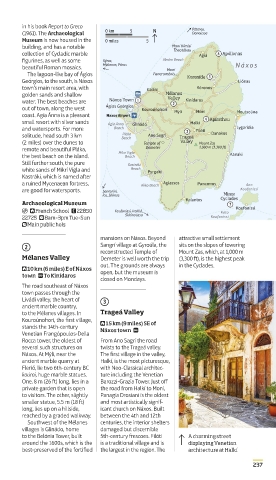
       to the Belónia Tower, built   5th-century frescoes. Filóti    A charming street
       around the 1600s, which is the  is a traditional village and is   displaying Venetian
       best-preserved of the fortified   the largest in the region. The   architecture at Halkí
                                                                  237


   236-237_EW_Greek_Islands.indd   237                       28/11/2018   09:56

