


Page 242 - (DK Eyewitness) Travel Guide - Greek Islands
P. 242
EXPERIENCE  The Cyclades


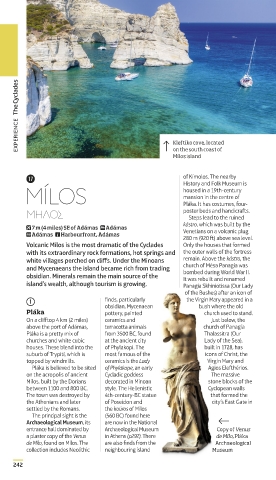
                                             Kleftiko cove, located
                                             on the south coast of
                                             Mílos island


        17                                      of Kímolos. The nearby
                                                History and Folk Museum is
          MÍLOS                                 housed in a 19th-century
                                                mansion in the centre of
        ΜΉΛΟΣ                                   Pláka. It has costumes, four-
                                                poster beds and handicrafts.
                                                  Steps lead to the ruined
                                                kástro, which was built by the
        k 7 m (4 miles) SE of Adámas   g Adámas
        @ Adámas   n Harbourfront, Adámas       Venetians on a volcanic plug
                                                280 m (920 ft) above sea level.
        Volcanic Mílos is the most dramatic of the Cyclades   Only the houses that formed
        with its extraordinary rock formations, hot springs and   the outer walls of the fortress
        white villages perched on cliffs. Under the Minoans   remain. Above the kástro, the
        and Mycenaeans the island became rich from trading   church of Mésa Panagía was
                                                bombed during World War II.
        obsidian. Minerals remain the main source of the   It was rebuilt and renamed
        island’s wealth, although tourism is growing.  Panagía Skhiniótissa (Our Lady
                                                of the Bushes) after an icon of
        1                   finds, particularly   the Virgin Mary appeared in a
                            obsidian, Mycenaean
                                                    bush where the old
        Pláka               pottery, painted         church used to stand.
        On a clifftop 4 km (2 miles)   ceramics and     Just below, the
        above the port of Adámas,   terracotta animals   church of Panagía
        Pláka is a pretty mix of   from 3500 BC, found   Thalassítra (Our
        churches and white cubic   at the ancient city     Lady of the Sea),
        houses. These blend into the   of Phylakopi. The   built in 1728, has
        suburb of Trypití, which is   most famous of the   icons of Christ, the
        topped by windmills.  ceramics is the Lady     Virgin Mary and
          Pláka is believed to be sited   of Phylakope, an early   Ágios Elefthérios.
        on the acropolis of ancient   Cycladic goddess     The massive
        Mílos, built by the Dorians   decorated in Minoan   stone blocks of the
        between 1100 and 800 BC.   style. The Hellenistic   Cyclopean walls
        The town was destroyed by   4th-century-BC statue     that formed the
        the Athenians and later   of Poseidon and      city’s East Gate in
        settled by the Romans.  the koúros of Mílos
          The principal sight is the   (560 BC) found here
        Archaeological Museum, its   are now in the National
        entrance hall dominated by     Archaeological Museum    Copy of Venus
        a plaster copy of the Venus    in Athens (p292). There   de Milo, Pláka
        de Milo, found on Mílos. The   are also finds from the   Archaeological
        collection includes Neolithic   neigh bouring island   Museum
    242


   242-243_EW_Greek_Islands.indd   242                       28/11/2018   11:44


 EW Must-see template v2 – 12th July 2018
 Fonts: Aptifer Sans LT Pro, Posterama Text, Soho Gothic
 Pro, Soho Pro, ITC Caslon 224

