


Page 245 - (DK Eyewitness) Travel Guide - Greek Islands
P. 245
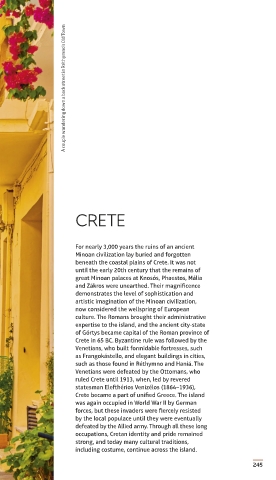
A couple wandering down a back street in Réthymno’s Old Town


                    CRETE


                    For nearly 3,000 years the ruins of an ancient
                    Minoan civilization lay buried and forgotten
                    beneath the coastal plains of Crete. It was not
                    until the early 20th century that the remains of
                    great Minoan palaces at Knosós, Phaestos, Mália
                    and Zákros were unearthed. Their magnificence
                    demonstrates the level of sophistication and
                    artistic imagination of the Minoan civilization,
                    now considered the wellspring of European
                    culture. The Romans brought their administrative
                    expertise to the island, and the ancient city-state
                    of Górtys became capital of the Roman province of
                    Crete in 65 BC. Byzantine rule was followed by the
                    Venetians, who built formidable fortresses, such
                    as Frangokástello, and elegant buildings in cities,
                    such as those found in Réthymno and Haniá. The
                    Venetians were defeated by the Ottomans, who
                    ruled Crete until 1913, when, led by revered
                    statesman Elefthérios Venizélos (1864–1936),
                    Crete became a part of unified Greece. The island
                    was again occupied in World War II by German
                    forces, but these invaders were fiercely resisted
                    by the local populace until they were eventually
                    defeated by the Allied army. Through all these long
                    occupations, Cretan identity and pride remained
                    strong, and today many cultural traditions,
                    including costume, continue across the island.
                                                                  245


   244-245_EW_Greek_Islands.indd   245                       28/11/2018   09:56

