


Page 283 - (DK Eyewitness) Travel Guide - Greek Islands
P. 283
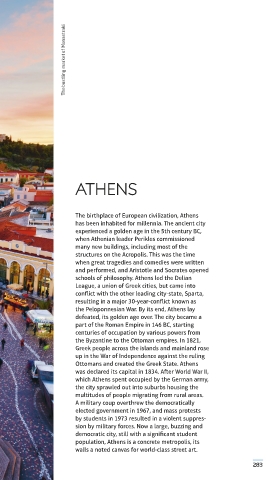
The bustling  market of  Monastraki


                    ATHENS


                    The birthplace of European civilization, Athens
                    has been inhabited for millennia. The ancient city
                    experienced a golden age in the 5th century BC,
                    when Athenian leader Perikles commissioned
                    many new buildings, including most of the
                    structures on the Acropolis. This was the time
                    when great tragedies and comedies were written
                    and performed, and Aristotle and Socrates opened
                    schools of philosophy. Athens led the Delian
                    League, a union of Greek cities, but came into
                    conflict with the other leading city-state, Sparta,
                    resulting in a major 30-year-conflict known as
                    the Peloponnesian War. By its end, Athens lay
                    defeated, its golden age over. The city became a
                    part of the Roman Empire in 146 BC, starting
                    centuries of occupation by various powers from
                    the Byzantine to the Ottoman empires. In 1821,
                    Greek people across the islands and mainland rose
                    up in the War of Independence against the ruling
                    Ottomans and created the Greek State. Athens
                    was declared its capital in 1834. After World War II,
                    which Athens spent occupied by the German army,
                    the city sprawled out into suburbs housing the
                    multitudes of people migrating from rural areas.
                    A military coup overthrew the democratically
                    elected government in 1967, and mass protests
                    by students in 1973 resulted in a violent suppres-
                    sion by military forces. Now a large, buzzing and
                    democratic city, still with a significant student
                    population, Athens is a concrete metropolis, its
                    walls a noted canvas for world-class street art.
                                                                  283


   282-283_EW_Greek_Islands.indd   283                       28/11/2018   09:56

