


Page 291 - (DK Eyewitness) Travel Guide - Greek Islands
P. 291
Must See
The Parthenon
Highlights ▶ One of the world’s most recognizable structures,
work began on the Parthenon in 447 BC, when the
sculptor Pheidias was entrusted with
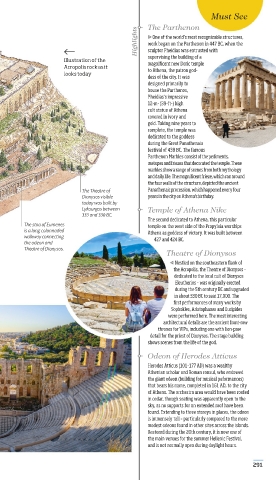
Illustration of the supervising the building of a
Acropolis rock as it magnificent new Doric temple
to Athena, the patron god
looks today
dess of the city. It was
designed primarily to
house the Parthenos,
Pheidias’s impressive
12m (39ft) high
cult statue of Athena
covered in ivory and
gold. Taking nine years to
complete, the temple was
dedicated to the goddess
during the Great Panathenaia
festival of 438 BC. The famous
Parthenon Marbles consist of the pedi ments,
metopes and friezes that decorated the temple. These
marbles show a range of scenes from both mythology
and daily life. The magnifi cent frieze, which ran around
the four walls of the structure, depicted the ancient
The Theatre of Panathenaic procession, which happened every four
Dionysos visible years in the city on Athena's birthday.
today was built by
Lykourgos between Temple of Athena Nike
333 and 330 BC.
The second dedicated to Athena, this particular
The stoa of Eumenes temple on the west side of the Propylaia worships
is a long colonnaded Athena as goddess of victory. It was built between
walkway connecting 427 and 424 BC.
the odeon and
Theatre of Dionysos.
Theatre of Dionysos
◀ Nestled on the southeastern flank of
the Acropolis, the Theatre of Dionysos –
dedicated to the local cult of Dionysos
Eleutherios – was originally erected
during the 5th century BC and upgraded
in about 330 BC to seat 17,000. The
first performances of many works by
Sophokles, Aristophanes and Euripides
were performed here. The most interesting
architectural details are the ancient frontrow
thrones for VIPs, including one with lionpaw
detail for the priest of Dionysos. The stage building
shows scenes from the life of the god.
Odeon of Herodes Atticus
Herodes Atticus (101–177 AD) was a wealthy
Athenian scholar and Roman consul, who endowed
the giant odeon (building for musical peformances)
that bears his name, completed in 161 AD, to the city
of Athens. The orchestra area would have been roofed
in cedar, though seating was apparently open to the
sky, as no supports for an extended roof have been
found. Extending to three storeys in places, the odeon
is immensely tall – particularly compared to the more
modest odeons found in other sites across the islands.
Restored during the 20th century, it is now one of
the main venues for the summer Hellenic Festival,
and is not normally open during daylight hours.
291
288-291_EW_Greek_Islands.indd 291 28/11/2018 09:56

