


Page 39 - All About History - Issue 18-14
P. 39
Heroes & Villains


                                                                                                               EMPEROR MEIJI


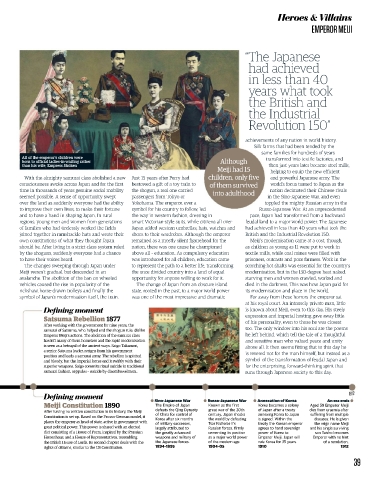
                                                                                       “ The Japanese

                                                                                        had achieved
                                                                                        in less than 40

                                                                                        years what took
                                                                                        the British and

                                                                                        the Industrial
                                                                                        Revolution 150”


                                                                                       achievements of any nation in world history.
                                                                                          Silk farms that had been tended by the
                                                                                             same families for hundreds of years
         All of the emperor’s children were                                                   transformed into textile factories, and
         born to official ladies-in-waiting rather                            Although
         than his wife, Empress Shōken                                                         then just years later became steel mills,
                                                                             Meiji had 15       helping to equip the new efficient
          Withthealmightysamuraiclassabolishedanew  Just 15 years after Perry had   children, only five   and powerful Japanese army. The
        consciousness awoke across Japan and for the first  bestowed a gift of a toy train to   of them survived   world’s focus turned to Japan as the
        time in thousands of years genuine social mobility  the shogun, a real one carried   into adulthood   nation decimated their Chinese rivals
        seemed possible. A sense of opportunity swept  passengers from Tokyo or                in the Sino-Japanese War, and even
        over thelandassuddenlyeveryonehadtheability  Yokohama. The emperor, ever a            toppled the mighty Russian army in the
        to improvetheirownlives,tomaketheirfortune  symbol for his country to follow, led   Russo-Japanese War. At an unprecedented
        and to have a hand in shaping Japan. In rural  the way in western fashion, dressing in   pace, Japan had transformed from a backward
        regions, youngmenandwomenfromgenerations  smart Victorian-style suits, while citizens all over   feudal land to a major world power. The Japanese
        of families who had tirelessly worked the fields  Japan added western umbrellas, hats, watches and   had achieved in less than 40 years what took the
        joined together in ramshackle huts and wrote their  shoes to their wardrobes. Although the emperor   British and the Industrial Revolution 150.
        own constitutions of what they thought Japan  remained as a mostly silent figurehead for the   Meiji’s modernisation came at a cost, though,
        should be.Afterlivinginastrictclasssystemruled  nation, there was one cause he championed   as children as young as 11 were put to work in
        by the shoguns, suddenly everyone had a chance  above all – education. As compulsory education   textile mills, while coal mines were filled with
        to have theirvoicesheard.              was introduced for all children, education came   prisoners, outcasts and poor farmers. Work in the
          The changes sweeping through Japan under  to represent the path to a better life, transforming   scorching-hot shafts was essential for the country’s
        Meiji weren’t gradual, but descended in an  the once divided country into a land of equal   modernisation, but in the 130-degree heat naked,
        avalanche. The abolition of the ban on wheeled  opportunity for anyone willing to work for it.  starving men and women crawled, worked and
        vehiclescausedtheriseinpopularityofthe   The change of Japan from an obscure island   died in the darkness. This was how Japan paid for
        rickshaw, horse-drawn trolleys and finally the  state, rooted in the past, to a major world power   its modernisation and place in the world.
        symbol of Japan’s modernisation itself, the train.  was one of the most impressive and dramatic   For away from these horrors the emperor sat
                                                                                       at his royal court. An intensely private man, little
                Defining moment                                                         is known about Meiji, even to this day. His steely
                                                                                       expression and imperial hosting gave away little
                Satsuma Rebellion 1877
                Afterworkingwiththegovernmentfornineyears,the                          of his personality, even to those he was closest
                samuraiofSatsuma,whohelpedendtheshogunrule,dislike                     too. The only window into his soul are the poems
                Emperor Meiji’s actions. The abolition of the samurai class            he left behind, which tell the tale of a thoughtful
                hasleftmanyofthemhomelessandtherapidmodernisation                      and sensitive man who valued peace and unity
                isseenasabetrayaloftheancientways.SaigoTakamori,                       above all. It then seems fitting that to this day he
                aseniorSatsumaleader,resignsfromhisgovernment
                position and leads a samurai army. The rebellion is spirited           is revered not for the man himself, but instead as a
                andbloody,buttheimperialforcesenditswiftlywiththeir                    symbol of the transformation of feudal Japan and
                superior weapons. Saigo commits ritual suicide in traditional          for the enterprising, forward-thinking spirit that
                samurai fashion, seppuku – suicide by disembowelment.                  runs through Japanese society to this day.


                Defining moment                                                                                              1912
                                                      O Sino-Japanese War  O Russo-Japanese War  O Annexation of Korea   An era ends O
                Meiji Constitution 1890                 TheEmpireofJapan  Known as the first  Korea becomes a colony   Aged 59 Emperor Meiji
                                                        defeats the Qing Dynasty  great war of the 20th  of Japan after a treaty   dies from uraemia after
                After having no written constitution in its history, the Meiji
                                                        of China for control of  century, Japan shocks  annexing Korea to Japan   suffering from multiple
                Constitution is set up. Based on the Prusso-German model, it
                                                        Korea after six months  the world by defeating  is signed. Within the   diseases.Heisgiven
                places the emperor as head of state, active in government with
                                                        of military successes,  Tsar Nicholas II’s   treaty the Korean emperor   the reign name Meiji
                great political power. This power is shared with an elected   largely attributed to  Russian forces, firmly  agrees to hand sovereign   and his single surviving
                diet consisting of a House of Peers, inspired by the Prussian   the greatly advanced  cementing its position  power of Korea to   sonTaishobecomes
                Herrenhaus, and a House of Representatives, resembling   weapons and military of  as a major world power  Emperor Meiji. Japan will   Emperorwithnohint
                the British House of Lords. Its second chapter deals with the   the Japanese forces.  of the modern age.  rule Korea for 35 years.    ofarevolution.
                rights of citizens, similar to the US Constitution.  1894-1895  1904-05     1910                         1912
                                                                                                                             39

