


Page 125 - Guitar Classics Magazine - The Les Paul Bible 2019
P. 125
THE ULTIMATE GUIDE TO VINTAGE LES PAUL TONE


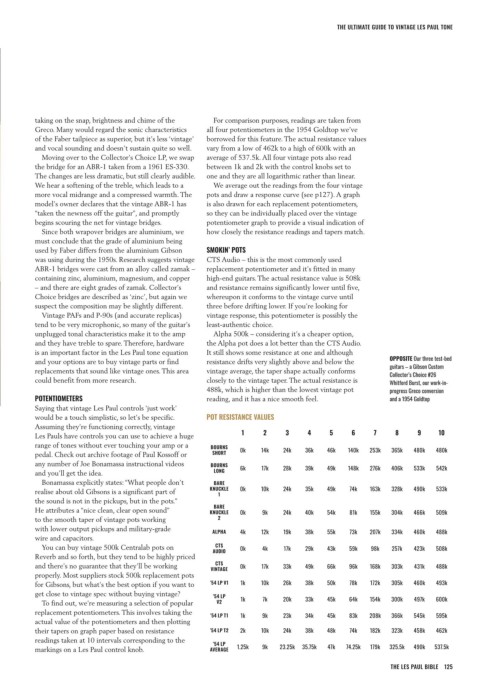
          taking on the snap, brightness and chime of the   For comparison purposes, readings are taken from
          Greco. Many would regard the sonic characteristics   all four potentiometers in the 1954 Goldtop we’ve
          of the Faber tailpiece as superior, but it’s less ‘vintage’   borrowed for this feature. The actual resistance values
          and vocal sounding and doesn’t sustain quite so well.  vary from a low of 462k to a high of 600k with an
           Moving over to the Collector’s Choice LP, we swap   average of 537.5k. All four vintage pots also read
          the bridge for an ABR-1 taken from a 1961 ES-330.   between 1k and 2k with the control knobs set to
          The changes are less dramatic, but still clearly audible.   one and they are all logarithmic rather than linear.
          We hear a softening of the treble, which leads to a   We average out the readings from the four vintage
          more vocal midrange and a compressed warmth. The   pots and draw a response curve (see p127). A graph
          model’s owner declares that the vintage ABR-1 has   is also drawn for each replacement potentiometers,
          “taken the newness off the guitar”, and promptly   so they can be individually placed over the vintage
          begins scouring the net for vintage bridges.   potentiometer graph to provide a visual indication of
           Since both wrapover bridges are aluminium, we   how closely the resistance readings and tapers match.
          must conclude that the grade of aluminium being
          used by Faber differs from the aluminium Gibson   SMOKIN’ POTS
          was using during the 1950s. Research suggests vintage   CTS Audio – this is the most commonly used
          ABR-1 bridges were cast from an alloy called zamak –   replacement potentiometer and it’s fitted in many
          containing zinc, aluminium, magnesium, and copper   high-end guitars. The actual resistance value is 508k
          – and there are eight grades of zamak. Collector’s   and resistance remains significantly lower until five,
          Choice bridges are described as ‘zinc’, but again we   whereupon it conforms to the vintage curve until
          suspect the composition may be slightly different.  three before drifting lower. If you’re looking for
           Vintage PAFs and P-90s (and accurate replicas)   vintage response, this potentiometer is possibly the
          tend to be very microphonic, so many of the guitar’s   least-authentic choice.
          unplugged tonal characteristics make it to the amp   Alpha 500k – considering it’s a cheaper option,
          and they have treble to spare. Therefore, hardware   the Alpha pot does a lot better than the CTS Audio.
          is an important factor in the Les Paul tone equation   It still shows some resistance at one and although
          and your options are to buy vintage parts or find   resistance drifts very slightly above and below the   OPPOSITE Our three test-bed
                                                                                                 guitars – a Gibson Custom
          replacements that sound like vintage ones. This area   vintage average, the taper shape actually conforms   Collector’s Choice #26
          could benefit from more research.         closely to the vintage taper. The actual resistance is   Whitford Burst, our work-in-
                                                    488k, which is higher than the lowest vintage pot   progress Greco conversion
          POTENTIOMETERS                            reading, and it has a nice smooth feel.      and a 1954 Goldtop
          Saying that vintage Les Paul controls ‘just work’
          would be a touch simplistic, so let’s be specific.   POT RESISTANCE VALUES
          Assuming they’re functioning correctly, vintage
          Les Pauls have controls you can use to achieve a huge   1  2  3    4     5    6    7     8    9     10
          range of tones without ever touching your amp or a   BOURNS
          pedal. Check out archive footage of Paul Kossoff or   SHORT  0k  14k  24k  36k  46k  140k  253k  365k  480k  480k
          any number of Joe Bonamassa instructional videos   BOURNS   6k  17k  28k  39k  49k  148k  276k  406k  533k  542k
          and you’ll get the idea.                    LONG
           Bonamassa explicitly states: “What people don’t   BARE
          realise about old Gibsons is a significant part of    KNUCKLE   0k  10k  24k  35k  49k  74k  163k  328k  490k  533k
                                                       1
          the sound is not in the pickups, but in the pots.”
                                                      BARE
          He attributes a “nice clean, clear open sound”    KNUCKLE   0k  9k  24k  40k  54k  81k  155k  304k  466k  509k
          to the smooth taper of vintage pots working    2
          with lower output pickups and military-grade
                                                      ALPHA  4k   12k  19k   38k  55k  73k   207k  334k  460k  488k
          wire and capacitors.
           You can buy vintage 500k Centralab pots on   CTS   0k  4k   17k   29k  43k  59k   98k  257k  423k  508k
                                                      AUDIO
          Reverb and so forth, but they tend to be highly priced
          and there’s no guarantee that they’ll be working   CTS   0k  17k  33k  49k  66k  96k  168k  303k  431k  488k
                                                     VINTAGE
          properly. Most suppliers stock 500k replacement pots
          for Gibsons, but what’s the best option if you want to   ’54 LP V1  1k  10k  26k  38k  50k  78k  172k  305k  460k  493k
          get close to vintage spec without buying vintage?  ’54 LP
           To find out, we’re measuring a selection of popular   V2  1k  7k  20k  33k  45k  64k  154k  300k  497k  600k
          replacement potentiometers. This involves taking the
                                                     ’54 LP T1  1k  9k  23k  34k  45k  83k  208k  366k  545k  595k
          actual value of the potentiometers and then plotting
          their tapers on graph paper based on resistance   ’54 LP T2  2k  10k  24k  38k  48k  74k  182k  323k  458k  462k
          readings taken at 10 intervals corresponding to the
                                                      ’54 LP
          markings on a Les Paul control knob.       AVERAGE  1.25k  9k  23.25k  35.75k  47k  74.25k  179k  325.5k  490k  537.5k

                                                                                                  THE LES PAUL BIBLE  125

