


Page 128 - Guitar Classics Magazine - The Les Paul Bible 2019
P. 128
THE ULTIMATE GUIDE TO VINTAGE LES PAUL TONE


                                                                        around five, rolling back the tone introduces a mid
                                                                        scoop that actually enhances clarity. The centre
                                                                        frequency even appears to change slightly depending
                                                                        on the volume and tone settings. So, the tone acts as
                                                                        both a treble roll-off and a rudimentary parametric
                                                                        equalizer – depending on how the controls are set.
                                                                          If you listen carefully, you can hear this with
                                                                        regular 500k pots and 0.022uF caps, but we suspect
                                                                        an upwards drift in actual cap value might accentuate
                                                                        the effect.
                                                                        PICKUPS
                                                                        This is the big one – and if you get the right type of
                                                                        pickups in your Les Paul, it can have a very profound
                                                                        effect. At the very least, your P-90 or PAF replicas
                                                                        will need to have suitable alnico magnets, steel parts
                                                                        with low carbon content, plain enamel magnet wire
                                                                        and no wax potting. In the case of PAF replicas, the
                                                                        coils will be slightly mismatched.
                                                                          If you can get those bases covered, you may wish to
                                                                        research the tones associated with different grades of
                                                                        alnico and decide whether you want early style P-90s
                                                                        with A3 or late-50s style with A5. Also research the
                                                                        range of DC resistance readings of vintage pickups
                                                                        and consider how that will impact tone.
                                                                          If you’re ordering from a boutique maker, you
                                                                        will no doubt be able to discuss your requirements
                                                                        and allow the experts to guide you. For this feature,
                                                                        we’re actually more concerned with getting the best
                                                                        from your pickups rather than identifying the ‘best’
                                                                        pickups per se.
                                                                          An old pro-audio old adage says the best
                                                                        microphone in the world is the one you have.
                                                                        What it means is that so long as a mic is of a certain
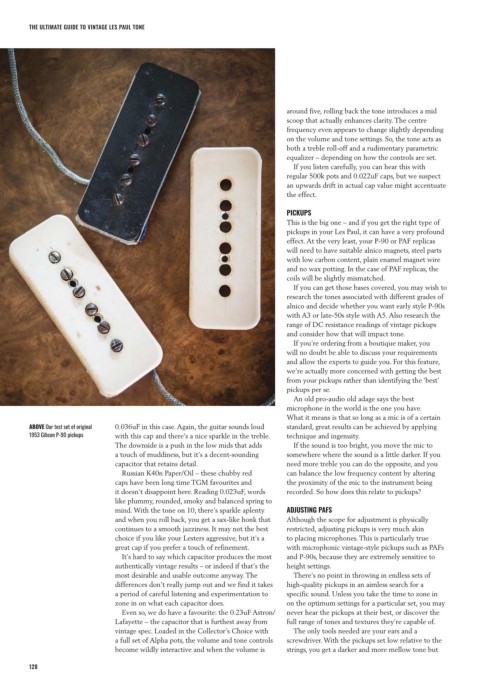
        ABOVE Our test set of original   0.036uF in this case. Again, the guitar sounds loud   standard, great results can be achieved by applying
        1953 Gibson P-90 pickups  with this cap and there’s a nice sparkle in the treble.   technique and ingenuity.
                             The downside is a push in the low mids that adds   If the sound is too bright, you move the mic to
                             a touch of muddiness, but it’s a decent-sounding   somewhere where the sound is a little darker. If you
                             capacitor that retains detail.             need more treble you can do the opposite, and you
                               Russian K40n Paper/Oil – these chubby red    can balance the low frequency content by altering
                             caps have been long time TGM favourites and    the proximity of the mic to the instrument being
                             it doesn’t disappoint here. Reading 0.023uF, words   recorded. So how does this relate to pickups?
                             like plummy, rounded, smoky and balanced spring to
                             mind. With the tone on 10, there’s sparkle aplenty   ADJUSTING PAFS
                             and when you roll back, you get a sax-like honk that   Although the scope for adjustment is physically
                             continues to a smooth jazziness. It may not the best   restricted, adjusting pickups is very much akin
                             choice if you like your Lesters aggressive, but it’s a   to placing microphones. This is particularly true
                             great cap if you prefer a touch of refinement.  with microphonic vintage-style pickups such as PAFs
                               It’s hard to say which capacitor produces the most   and P-90s, because they are extremely sensitive to
                             authentically vintage results – or indeed if that’s the   height settings.
                             most desirable and usable outcome anyway. The   There’s no point in throwing in endless sets of
                             differences don’t really jump out and we find it takes   high-quality pickups in an aimless search for a
                             a period of careful listening and experimentation to   specific sound. Unless you take the time to zone in
                             zone in on what each capacitor does.       on the optimum settings for a particular set, you may
                               Even so, we do have a favourite: the 0.23uF Astron/  never hear the pickups at their best, or discover the
                             Lafayette – the capacitor that is furthest away from   full range of tones and textures they’re capable of.
                             vintage spec. Loaded in the Collector’s Choice with   The only tools needed are your ears and a
                             a full set of Alpha pots, the volume and tone controls   screwdriver. With the pickups set low relative to the
                             become wildly interactive and when the volume is   strings, you get a darker and more mellow tone but

        128

