


Page 16 - Guitar Classics Magazine - The Les Paul Bible 2019
P. 16
THE ORAL HISTORY OF THE LES PAUL


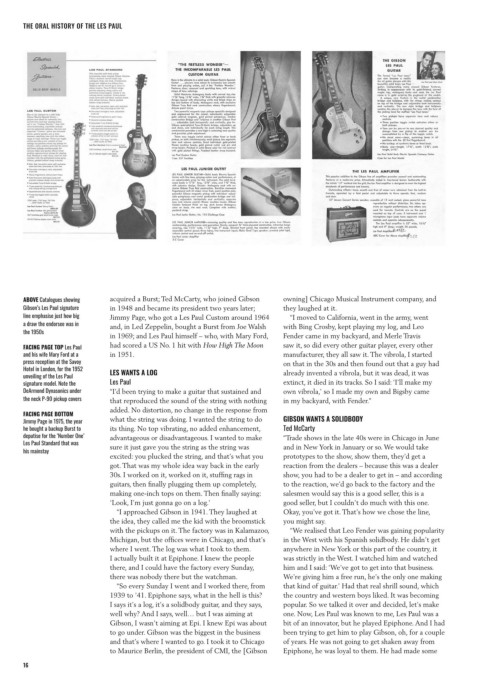
       ABOVE Catalogues showing   acquired a Burst; Ted McCarty, who joined Gibson   owning] Chicago Musical Instrument company, and
       Gibson’s Les Paul signature   in 1948 and became its president two years later;   they laughed at it.
       line emphasise just how big   Jimmy Page, who got a Les Paul Custom around 1964   “I moved to California, went in the army, went
       a draw the endorsee was in   and, in Led Zeppelin, bought a Burst from Joe Walsh   with Bing Crosby, kept playing my log, and Leo
       the 1950s
                            in 1969; and Les Paul himself – who, with Mary Ford,   Fender came in my backyard, and Merle Travis
       FACING PAGE TOP Les Paul   had scored a US No. 1 hit with How High The Moon   saw it, so did every other guitar player, every other
       and his wife Mary Ford at a   in 1951.                          manufacturer, they all saw it. The vibrola, I started
       press reception at the Savoy                                    on that in the 30s and then found out that a guy had
       Hotel in London, for the 1952
       unveiling of the Les Paul   LES WANTS A LOG                     already invented a vibrola, but it was dead, it was
       signature model. Note the   Les Paul                            extinct, it died in its tracks. So I said: ‘I’ll make my
       DeArmond Dynasonics under   “I’d been trying to make a guitar that sustained and   own vibrola,’ so I made my own and Bigsby came
       the neck P-90 pickup covers  that reproduced the sound of the string with nothing   in my backyard, with Fender.”
                            added. No distortion, no change in the response from
       FACING PAGE BOTTOM
       Jimmy Page in 1975, the year   what the string was doing. I wanted the string to do   GIBSON WANTS A SOLIDBODY
       he bought a backup Burst to   its thing. No top vibrating, no added enhancement,   Ted McCarty
       deputise for the ‘Number One’   advantageous or disadvantageous. I wanted to make   “Trade shows in the late 40s were in Chicago in June
       Les Paul Standard that was    sure it just gave you the string as the string was   and in New York in January or so. We would take
       his mainstay
                            excited: you plucked the string, and that’s what you   prototypes to the show, show them, they’d get a
                            got. That was my whole idea way back in the early   reaction from the dealers – because this was a dealer
                            30s. I worked on it, worked on it, stufing rags in   show, you had to be a dealer to get in – and according
                            guitars, then inally plugging them up completely,   to the reaction, we’d go back to the factory and the
                            making one-inch tops on them. Then inally saying:   salesmen would say this is a good seller, this is a
                            ‘Look, I’m just gonna go on a log.’        good seller, but I couldn’t do much with this one.
                              “I approached Gibson in 1941. They laughed at   Okay, you’ve got it. That’s how we chose the line,
                            the idea, they called me the kid with the broomstick   you might say.
                            with the pickups on it. The factory was in Kalamazoo,   “We realised that Leo Fender was gaining popularity
                            Michigan, but the ofices were in Chicago, and that’s   in the West with his Spanish solidbody. He didn’t get
                            where I went. The log was what I took to them.     anywhere in New York or this part of the country, it
                            I actually built it at Epiphone. I knew the people   was strictly in the West. I watched him and watched
                            there, and I could have the factory every Sunday,    him and I said: ‘We’ve got to get into that business.
                            there was nobody there but the watchman.   We’re giving him a free run, he’s the only one making
                              “So every Sunday I went and I worked there, from   that kind of guitar.’ Had that real shrill sound, which
                            1939 to ’41. Epiphone says, what in the hell is this?   the country and western boys liked. It was becoming
                            I says it’s a log, it’s a solidbody guitar, and they says,   popular. So we talked it over and decided, let’s make
                            well why? And I says, well… but I was aiming at   one. Now, Les Paul was known to me, Les Paul was a
                            Gibson, I wasn’t aiming at Epi. I knew Epi was about   bit of an innovator, but he played Epiphone. And I had
                            to go under. Gibson was the biggest in the business   been trying to get him to play Gibson, oh, for a couple
                            and that’s where I wanted to go. I took it to Chicago   of years. He was not going to get shaken away from
                            to Maurice Berlin, the president of CMI, the [Gibson   Epiphone, he was loyal to them. He had made some

       16

