


Page 25 - Guitar Classics Magazine - The Les Paul Bible 2019
P. 25
REVIEWS


          the move to squarer corners on the jack socket plates.
          The key updates from a playability standpoint were
          the arrival of wider fretwire and slightly slimmer
          neck dimensions, while the most desirable period also
          coincided with the serial-number range in which the
          red pigment in the guitars’ sunburst finishes was most
          susceptible to fading when exposed to UV light.
           Although the more colour-fast ‘tomato soup’ Bursts
          with thinner necks from later in 1960 are regarded
          as less appealing by some hardcore Les Paul fanatics,
          we’re still talking about some of the best electric
          guitars ever made, with a monetary value way beyond
          the reach of 95 per cent of the population. Yet for
          the most part, it’s the ’59 – aided and abetted by the
          adoration of a laundry list of rock luminaries – that
          holds the most allure.

          REWIND THE TAPE
          Celebrating six decades of the most famous guitar
          in its back catalogue, the newly reinvigorated
          Gibson unveiled the 60th Anniversary 1959 Les Paul
          Standard at Winter NAMM 2019. Despite the doom
          and gloom surrounding the company’s finances, the
          Custom division has been doing some stellar work in
          recent years and our review guitar benefits directly
          from the research and development that went into
          True Historic and Collector’s Choice. With True
          Historic now discontinued and the Collector’s Choice
          concept having run its course, there’s still scope to
          use the data, hardware and manufacturing techniques
          to inform new reissue models.
           This manifests itself here in a top and neck carve
          taken from the Collector’s Choice #37 ‘Carmelita’
          model, (created by 3D scanning the original Les Paul,
          serial number 9 1953) and the presence of plastics
          recreated for the True Historic programme unveiled
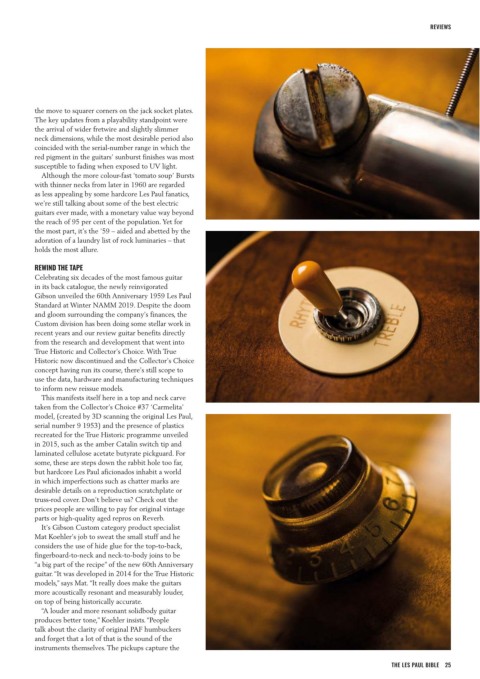
          in 2015, such as the amber Catalin switch tip and
          laminated cellulose acetate butyrate pickguard. For
          some, these are steps down the rabbit hole too far,
          but hardcore Les Paul aficionados inhabit a world
          in which imperfections such as chatter marks are
          desirable details on a reproduction scratchplate or
          truss-rod cover. Don’t believe us? Check out the
          prices people are willing to pay for original vintage
          parts or high-quality aged repros on Reverb.
           It’s Gibson Custom category product specialist
          Mat Koehler’s job to sweat the small stuff and he
          considers the use of hide glue for the top-to-back,
          fingerboard-to-neck and neck-to-body joins to be
          “a big part of the recipe” of the new 60th Anniversary
          guitar. “It was developed in 2014 for the True Historic
          models,” says Mat. “It really does make the guitars
          more acoustically resonant and measurably louder,
          on top of being historically accurate.
           “A louder and more resonant solidbody guitar
          produces better tone,” Koehler insists. “People
          talk about the clarity of original PAF humbuckers
          and forget that a lot of that is the sound of the
          instruments themselves. The pickups capture the

                                                                                                  THE LES PAUL BIBLE  25

