


Page 47 - Guitar Classics Magazine - The Les Paul Bible 2019
P. 47
THE MAN BEHIND THE GUITAR


                                                     © Getty Images/Andrew Lepley


          LES PAUL

          THE MAN


          BEHIND THE GUITAR


          Lester Polsfuss was much more than the
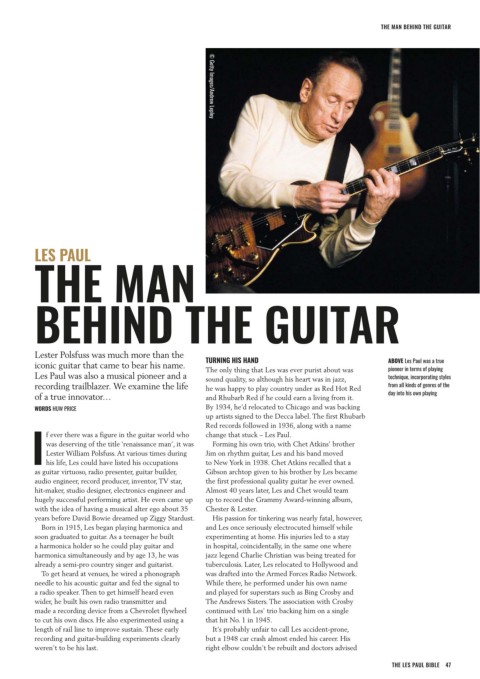
          iconic guitar that came to bear his name.   TURNING HIS HAND                           ABOVE Les Paul was a true
                                                                                                 pioneer in terms of playing
                                                    The only thing that Les was ever purist about was
          Les Paul was also a musical pioneer and a   sound quality, so although his heart was in jazz,    technique, incorporating styles
          recording trailblazer. We examine the life   he was happy to play country under as Red Hot Red   from all kinds of genres of the
          of a true innovator…                      and Rhubarb Red if he could earn a living from it.    day into his own playing
          WORDS HUW PRICE                           By 1934, he’d relocated to Chicago and was backing
                                                    up artists signed to the Decca label. The first Rhubarb
                                                    Red records followed in 1936, along with a name
            f ever there was a figure in the guitar world who   change that stuck – Les Paul.
            was deserving of the title ‘renaissance man’, it was   Forming his own trio, with Chet Atkins’ brother
            Lester William Polsfuss. At various times during   Jim on rhythm guitar, Les and his band moved
         I his life, Les could have listed his occupations   to New York in 1938. Chet Atkins recalled that a
          as guitar virtuoso, radio presenter, guitar builder,   Gibson archtop given to his brother by Les became
          audio engineer, record producer, inventor, TV star,   the first professional quality guitar he ever owned.
          hit-maker, studio designer, electronics engineer and   Almost 40 years later, Les and Chet would team
          hugely successful performing artist. He even came up   up to record the Grammy Award-winning album,
          with the idea of having a musical alter ego about 35   Chester & Lester.
          years before David Bowie dreamed up Ziggy Stardust.  His passion for tinkering was nearly fatal, however,
           Born in 1915, Les began playing harmonica and   and Les once seriously electrocuted himself while
          soon graduated to guitar. As a teenager he built   experimenting at home. His injuries led to a stay
          a harmonica holder so he could play guitar and   in hospital, coincidentally, in the same one where
          harmonica simultaneously and by age 13, he was   jazz legend Charlie Christian was being treated for
          already a semi-pro country singer and guitarist.   tuberculosis. Later, Les relocated to Hollywood and
           To get heard at venues, he wired a phonograph   was drafted into the Armed Forces Radio Network.
          needle to his acoustic guitar and fed the signal to    While there, he performed under his own name
          a radio speaker. Then to get himself heard even    and played for superstars such as Bing Crosby and
          wider, he built his own radio transmitter and    The Andrews Sisters. The association with Crosby
          made a recording device from a Chevrolet flywheel   continued with Les’ trio backing him on a single
          to cut his own discs. He also experimented using a   that hit No. 1 in 1945.
          length of rail line to improve sustain. These early   It’s probably unfair to call Les accident-prone,
          recording and guitar-building experiments clearly   but a 1948 car crash almost ended his career. His
          weren’t to be his last.                   right elbow couldn’t be rebuilt and doctors advised

                                                                                                   THE LES PAUL BIBLE  47

