


Page 50 - Guitar Classics Magazine - The Les Paul Bible 2019
P. 50
THE MAN BEHIND THE GUITAR


           BY 1952, GIBSON HAD BEEN SHAKEN

                     OUT OF ITS COMPLACENCY BY
               FENDER’S SUCCESS AND THE REST

                 IS HISTORY. LES COLLABORATED                           can hear its distinctive tone on Somebody Loves Me,
                                                                        recorded in 1947. Unfortunately, the design proved
                       ON THE DESIGN AND TESTING                        problematic under hot stage lights.
                                                                          Then out of the blue, Les got an unexpected
                                                                        call. By 1952, Gibson had been shaken out of its
                                                                        complacency by Fender’s success and the rest is
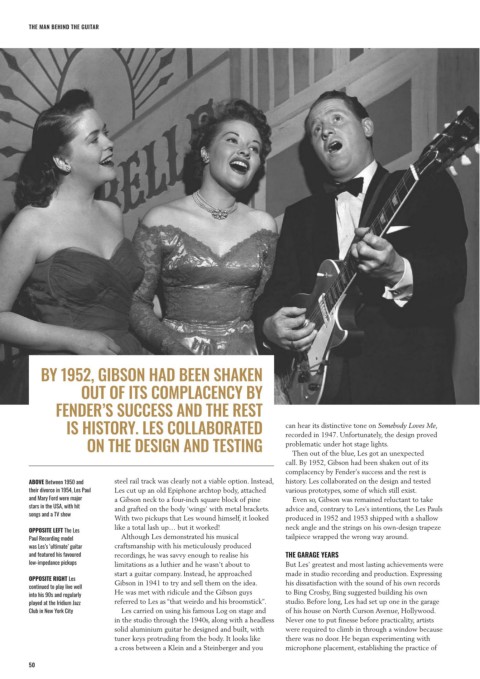
        ABOVE Between 1950 and   steel rail track was clearly not a viable option. Instead,   history. Les collaborated on the design and tested
        their divorce in 1954, Les Paul   Les cut up an old Epiphone archtop body, attached    various prototypes, some of which still exist.
        and Mary Ford were major   a Gibson neck to a four-inch square block of pine    Even so, Gibson was remained reluctant to take
        stars in the USA, with hit
                             and grafted on the body ‘wings’ with metal brackets.   advice and, contrary to Les’s intentions, the Les Pauls
        songs and a TV show
                             With two pickups that Les wound himself, it looked   produced in 1952 and 1953 shipped with a shallow
                             like a total lash up… but it worked!       neck angle and the strings on his own-design trapeze
        OPPOSITE LEFT The Les
        Paul Recording model    Although Les demonstrated his musical   tailpiece wrapped the wrong way around.
        was Les’s ‘ultimate’ guitar    craftsmanship with his meticulously produced
        and featured his favoured   recordings, he was savvy enough to realise his   THE GARAGE YEARS
        low-impedance pickups  limitations as a luthier and he wasn’t about to    But Les’ greatest and most lasting achievements were
                             start a guitar company. Instead, he approached   made in studio recording and production. Expressing
        OPPOSITE RIGHT Les   Gibson in 1941 to try and sell them on the idea.    his dissatisfaction with the sound of his own records
        continued to play live well
        into his 90s and regularly   He was met with ridicule and the Gibson guys   to Bing Crosby, Bing suggested building his own
        played at the Iridium Jazz    referred to Les as “that weirdo and his broomstick”.   studio. Before long, Les had set up one in the garage
        Club in New York City  Les carried on using his famous Log on stage and    of his house on North Curson Avenue, Hollywood.
                             in the studio through the 1940s, along with a headless   Never one to put finesse before practicality, artists
                             solid aluminium guitar he designed and built, with   were required to climb in through a window because
                             tuner keys protruding from the body. It looks like   there was no door. He began experimenting with
                             a cross between a Klein and a Steinberger and you   microphone placement, establishing the practice of

        50

