


Page 70 - Guitar Classics Magazine - The Les Paul Bible 2019
P. 70
VINTAGE BENCH TEST


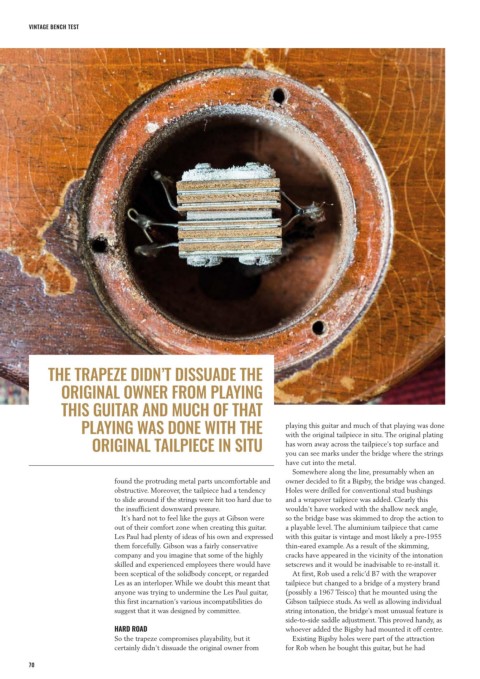
             THE TRAPEZE DIDN’T DISSUADE THE

                ORIGINAL OWNER FROM PLAYING
                THIS GUITAR AND MUCH OF THAT

                     PLAYING WAS DONE WITH THE                          playing this guitar and much of that playing was done
                                                                        with the original tailpiece in situ. The original plating
                        ORIGINAL TAILPIECE IN SITU                      has worn away across the tailpiece’s top surface and
                                                                        you can see marks under the bridge where the strings
                                                                        have cut into the metal.
                                                                          Somewhere along the line, presumably when an
                             found the protruding metal parts uncomfortable and   owner decided to fit a Bigsby, the bridge was changed.
                             obstructive. Moreover, the tailpiece had a tendency   Holes were drilled for conventional stud bushings
                             to slide around if the strings were hit too hard due to   and a wrapover tailpiece was added. Clearly this
                             the insufficient downward pressure.        wouldn’t have worked with the shallow neck angle,
                               It’s hard not to feel like the guys at Gibson were   so the bridge base was skimmed to drop the action to
                             out of their comfort zone when creating this guitar.   a playable level. The aluminium tailpiece that came
                             Les Paul had plenty of ideas of his own and expressed   with this guitar is vintage and most likely a pre-1955
                             them forcefully. Gibson was a fairly conservative   thin-eared example. As a result of the skimming,
                             company and you imagine that some of the highly   cracks have appeared in the vicinity of the intonation
                             skilled and experienced employees there would have   setscrews and it would be inadvisable to re-install it.
                             been sceptical of the solidbody concept, or regarded   At first, Rob used a relic’d B7 with the wrapover
                             Les as an interloper. While we doubt this meant that   tailpiece but changed to a bridge of a mystery brand
                             anyone was trying to undermine the Les Paul guitar,   (possibly a 1967 Teisco) that he mounted using the
                             this first incarnation’s various incompatibilities do   Gibson tailpiece studs. As well as allowing individual
                             suggest that it was designed by committee.   string intonation, the bridge’s most unusual feature is
                                                                        side-to-side saddle adjustment. This proved handy, as
                             HARD ROAD                                  whoever added the Bigsby had mounted it off centre.
                             So the trapeze compromises playability, but it   Existing Bigsby holes were part of the attraction
                             certainly didn’t dissuade the original owner from   for Rob when he bought this guitar, but he had

        70

