


Page 71 - Guitar Classics Magazine - The Les Paul Bible 2019
P. 71
VINTAGE BENCH TEST


          no intention of drilling any others and the Teisco’s
          sideways saddle adjustment provided a solution for
          realigning the strings without relocating the Bigsby.
          The Bigsby now residing on the guitar is another
          internet find and is purportedly a late 1950s original
          that had been fitted to an ES-335.
           Rob considers this the perfect set-up for his guitar,
          and he likes to think that Les Paul would have
          approved. After all, he was a practical and pragmatic
          man who generally favoured a properly functioning
          lash up over fine but flawed craftsmanship. Les was
          partial to a bit of Bigsby action, too and he reputedly
          gouged into the top of his first LP prototype with
          a heated screwdriver in order to lower the trapeze
          sufficiently for top wrapping.
           Les Pauls from the first year of production are not
          as rare as you might imagine. Supposedly only around
          1,500 Les Paul Standards were made between 1958
          and 1960, but company records show that Gibson
          sold 1,716 Goldtops in 1952 alone. Considering that
          the first ones didn’t reach the dealers until June, that
          was going some. Unfortunately, Gibson’s records
          don’t specify how many of those ’52s had unbound
          necks. However, unbound 1952 Goldtops are
          definitely in the minority and Rob’s guitar has some
          other unusual features that indicate it’s one of the
          very first Les Pauls ever made.
           As such, it is a particularly rare example. Examine
          the headstock and you’ll see there is no serial number,
          and the Gibson logo is set low on the peghead. Look
          closely at the logo and check out how the low-set
          ‘kissing dot’ touches the ‘G’.
           Now look down the neck and you’ll notice the
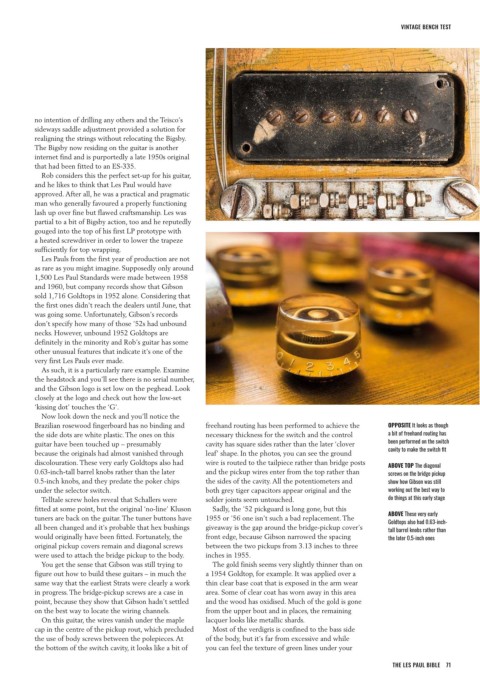
          Brazilian rosewood fingerboard has no binding and   freehand routing has been performed to achieve the   OPPOSITE It looks as though
          the side dots are white plastic. The ones on this    necessary thickness for the switch and the control   a bit of freehand routing has
          guitar have been touched up – presumably   cavity has square sides rather than the later ‘clover   been performed on the switch
                                                                                                 cavity to make the switch it
          because the originals had almost vanished through   leaf’ shape. In the photos, you can see the ground
          discolouration. These very early Goldtops also had   wire is routed to the tailpiece rather than bridge posts
                                                                                                 ABOVE TOP The diagonal
          0.63-inch-tall barrel knobs rather than the later    and the pickup wires enter from the top rather than   screws on the bridge pickup
          0.5-inch knobs, and they predate the poker chips   the sides of the cavity. All the potentiometers and   show how Gibson was still
          under the selector switch.                both grey tiger capacitors appear original and the   working out the best way to
           Telltale screw holes reveal that Schallers were   solder joints seem untouched.       do things at this early stage
          fitted at some point, but the original ‘no-line’ Kluson   Sadly, the ’52 pickguard is long gone, but this
                                                                                                 ABOVE These very early
          tuners are back on the guitar. The tuner buttons have   1955 or ’56 one isn’t such a bad replacement. The   Goldtops also had 0.63-inch-
          all been changed and it’s probable that hex bushings   giveaway is the gap around the bridge-pickup cover’s   tall barrel knobs rather than
          would originally have been fitted. Fortunately, the   front edge, because Gibson narrowed the spacing   the later 0.5-inch ones
          original pickup covers remain and diagonal screws   between the two pickups from 3.13 inches to three
          were used to attach the bridge pickup to the body.  inches in 1955.
           You get the sense that Gibson was still trying to   The gold finish seems very slightly thinner than on
          figure out how to build these guitars – in much the   a 1954 Goldtop, for example. It was applied over a
          same way that the earliest Strats were clearly a work   thin clear base coat that is exposed in the arm wear
          in progress. The bridge-pickup screws are a case in   area. Some of clear coat has worn away in this area
          point, because they show that Gibson hadn’t settled   and the wood has oxidised. Much of the gold is gone
          on the best way to locate the wiring channels.   from the upper bout and in places, the remaining
           On this guitar, the wires vanish under the maple   lacquer looks like metallic shards.
          cap in the centre of the pickup rout, which precluded   Most of the verdigris is confined to the bass side
          the use of body screws between the polepieces. At   of the body, but it’s far from excessive and while
          the bottom of the switch cavity, it looks like a bit of   you can feel the texture of green lines under your

                                                                                                   THE LES PAUL BIBLE  71

