


Page 225 - (DK Eyewitness) Travel Guide - New York City
P. 225
MORNINGSIDE HEIGHT S AND HARLEM 223
there was no such thing as “black
history.” The Carnegie Corporation
bought the collection in 1926
and gave it to the New York
Public Library; Schomburg
was made curator in 1932.
The library was the unofficial
meeting place for writers involved
in what later became known
as the Harlem Renaissance of
the 1920s, including Langston
Hughes, W. E. B. Du Bois, and
Zora Neale Hurston. It also
hosted many poetry readings
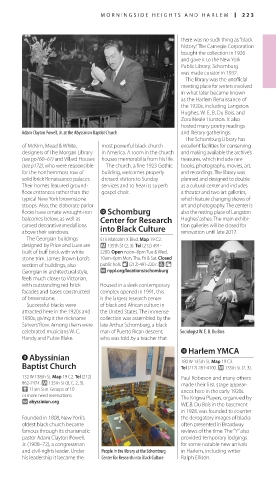
Adam Clayton Powell, Jr. at the Abyssinian Baptist Church and literary gatherings.
The Schomburg Library has
of McKim, Mead & White, most powerful black church excellent facilities for con serving
designers of The Morgan Library in America. A room in the church and making available the archive’s
(see pp160–61) and Villard Houses houses memorabilia from his life. treasures, which include rare
(see p172), who were responsible The church, a fine 1923 Gothic books, photographs, movies, art,
for the northernmost row of building, welcomes properly and recordings. The library was
solid brick Renaissance palaces. dressed visitors to Sunday planned and designed to double
Their homes featured ground- services and to hear its superb as a cultural center and includes
floor entrances rather than the gospel choir. a theater and two art galleries,
typical New York brownstone which feature changing shows of
stoops. Also, the elaborate parlor art and photography. The center is
floors have ornate wrought-iron w Schomburg also the resting place of Langston
balconies below, as well as Center for Research Hughes’ ashes. The main exhibi -
carved decorative medallions into Black Culture tion galleries will be closed for
above their windows. renovation until late 2017.
The Georgian buildings 515 Malcolm X Blvd. Map 19 C2.
designed by Price and Luce are q 135th St (2, 3). Tel (212) 491-
built of buff brick with white 2200. Open noon–8pm Tue & Wed,
stone trim. James Brown Lord’s 10am–6pm Mon, Thu, Fri & Sat. Closed
section of buildings, also public hols. 8 (212) 491-2207. 7 =
Georgian in architectural style, ∑ nypl.org/locations/schomburg
feels much closer to Victorian,
with outstanding red-brick Housed in a sleek contemporary
facades and bases constructed complex opened in 1991, this
of brownstone. is the largest research center
Successful blacks were of black and African culture in
attracted here in the 1920s and the United States. The immense
1930s, giving it the nickname collection was assembled by the
Strivers’ Row. Among them were late Arthur Schomburg, a black
celebrated musicians W. C. man of Puerto Rican descent, Sociologist W. E. B. Du Bois
Handy and Eubie Blake. who was told by a teacher that
e Harlem YMCA
q Abyssinian 180 W 135th St. Map 19 C3.
Baptist Church Tel (212) 281-4100. q 135th St (2, 3).
132 W 138th St. Map 19 C2. Tel (212) Paul Robeson and many others
862-7474. q 135th St (B, C, 2, 3). made their first stage appear-
5 11am Sun. Groups of 10 ances here in the early 1920s.
or more need reservations. The Krigwa Players, organized by
∑ abyssinian.org
W.E.B. Du Bois in the basement
in 1928, was founded to counter
Founded in 1808, New York’s the derogatory images of blacks
oldest black church became often presented in Broadway
famous through its charismatic reviews of the time. The “Y” also
pastor Adam Clayton Powell, provided temporary lodgings
Jr. (1908–72), a congressman for some notable new arrivals
and civil-rights leader. Under People in the library at the Schomburg in Harlem, including writer
his leadership it became the Center for Research into Black Culture Ralph Ellison.
222-223_EW_New_York_City.indd 223 4/3/17 11:12 AM

