


Page 34 - (DK Eyewitness) Travel Guide - New York City
P. 34
32 INTRODUCING NE W Y ORK CIT Y
Postwar New York City
Since World War II, New York has seen both the best of times
and the worst. In the 1940s, the city became the headquarters of
the United Nations (UN) and, in the 1950s, saw major movements
in art, poetry, and jazz. The 1960s witnessed the Stonewall Riots and
the birth of the American Gay Rights Movement. Although always
a dynamic cultural center, the city has seen ups and downs with
its economy. In 1975, New York almost went bankrupt under a
mountain of debt. Despite a recovery, led by Wall Street in the
early 1980s, the tough times continued, culminating in the
recession of 1989.
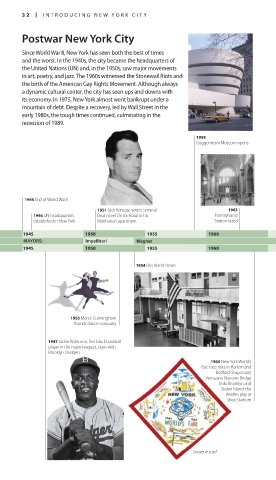
1959
Guggenheim Museum opens
1945 End of World War II
1951 Jack Kerouac writes seminal 1963
1946 UN headquarters Beat novel On the Road in his Pennsylvania
established in New York Manhattan apartment Station razed
1945 1950 1955 1960
MAYORS: Impelliteri Wagner
1945 1950 1955 1960
1954 Ellis Island closes
1953 Merce Cunningham
founds dance company
1947 Jackie Robinson, first black baseball
player in the major leagues, signs with
Brooklyn Dodgers
1964 New York World’s
Fair; race riots in Harlem and
Bedford-Stuyvesant;
Verrazano Narrows Bridge
links Brooklyn and
Staten Island; the
Beatles play at
Shea Stadium
Souvenir scarf
032-033_EW_New_York_City.indd 32 4/3/17 11:10 AM

