


Page 44 - (DK Eyewitness) Travel Guide - New York City
P. 44
42 INTRODUCING NE W Y ORK CIT Y
New York’s Best: Architecture
Even when following world trends, New York has given its
own twist to the turns of architectural fashion, the style of
its buildings influenced by both geography and economy.
An island city, with space at a premium, must look upward
to grow. This trend was reflected early on with tall, narrow
town houses and later with the city’s apartment buildings
and sky scrapers. Building materials such as cast-iron and Apartment Buildings
The Majestic is one of five
brownstone were chosen for their local availability and Art Deco twin-towered
low cost. The result is a apartment buildings on Midtown
city that has developed Central Park West. West and
by finding flamboyant the Theater
answers to practical needs. District
A more detailed overview
of New York’s architecture
is on pages 44–5.
Hudson R iver Chelsea
and the
Garment
District
Gramercy
Greenwich and the
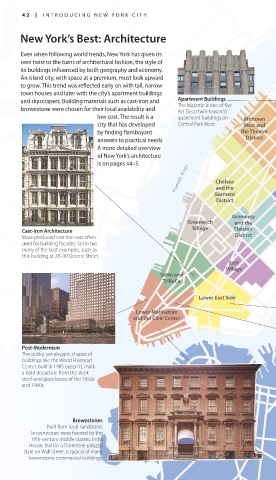
Cast-Iron Architecture Village Flatiron
Mass-produced cast iron was often District
used for building facades. SoHo has
many of the best examples, such as
this building at 28–30 Greene Street.
East East R iver
Village
SoHo and
TriBeCa
Lower East Side
Lower Manhattan
and the Civic Center
Post-Modernism
The quirky, yet elegant, shapes of
buildings like the World Financial
Center, built in 1985 (see p71), mark
a bold departure from the sleek
steel-and-glass boxes of the 1950s
and 1960s.
Brownstones
Built from local sand stone,
brownstones were favored by the
19th-century middle classes. India
House, built in a Florentine palazzo
style on Wall Street, is typical of many
brownstone commercial buildings.
042-043_EW_New_York_City.indd 42 4/3/17 11:40 AM

