


Page 46 - (DK Eyewitness) Travel Guide - New York City
P. 46
44 INTRODUCING NE W Y ORK CIT Y
Exploring New York’s Architecture
During its first 200 years, New York, like all of America, Cast-Iron Architecture
looked to Europe for architectural inspiration. None of An American architectural
the buildings from the Dutch colonial period survives in innovation of the 19th century,
Manhattan today; most were lost in the great fire of 1776 cast iron was cheaper than
stone or brick and allowed
or torn down to make way for new developments in the ornate features to be
early 1800s. Throughout the 18th and 19th centuries, the prefabricated in foundries
city’s major architectural trends followed those of Europe. from molds and used as
With the advent of cast-iron architecture in the 1850s, the building facades. Today, New
Art Deco period and the ever-higher rise of the skyscraper, York has the world’s largest
concen tration of full and partial
New York’s architecture came into its own.
cast-iron facades. The best, built
in the 1870s, are in the SoHo
Federal Architecture best examples of brownstone Cast-Iron Historic District.
This American adaptation of can be found in Chelsea.
the Neo-Classical Adam style Because street space was
flowered in the early decades limited, these buildings were
of the new nation, featuring very narrow in width, but also
square buildings two or three very deep. A typical brownstone
stories tall, with low hipped has a flight of steps, called a
roofs, balustrades, and decor- stoop, leading up to the living
ative elements – all carefully floors. Separate stairs lead
balanced. City Hall (1811, John down to the basement, which
McComb, Jr. and Joseph was originally used for the
François Mangin) is a blend servants’ quarters.
of Federal and French Renais-
sance influences. The restored Tenements
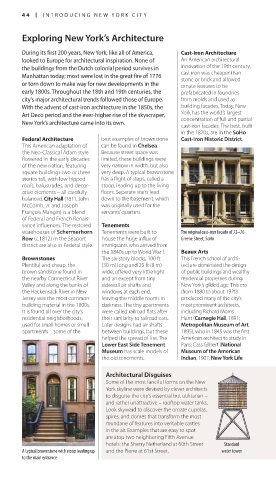
warehouses of Schermerhorn Tenements were built to The original cast-iron facade of 72–76
Row (c.1812) in the Seaport house the huge influx of Greene Street, SoHo
district are also in Federal style. immigrants who arrived from
the 1840s up to World War I. Beaux Arts
Brownstones The six-story blocks, 100 ft This French school of arch i-
Plentiful and cheap, the (30 m) long and 25 ft (8 m) tecture dominated the design
brown sandstone found in wide, offered very little light of public buildings and wealthy
the nearby Connecticut River and air except from tiny residential properties during
Valley and along the banks of side wall air shafts and New York’s gilded age. This era
the Hackensack River in New windows at each end, (from 1880 to about 1920)
Jersey was the most common leaving the middle rooms in produced many of the city’s
building material in the 1800s. darkness. The tiny apartments most prominent architects,
It is found all over the city’s were called railroad flats after including Richard Morris
residential neighborhoods, their similarity to railroad cars. Hunt (Carnegie Hall, 1891;
used for small homes or small Later designs had air shafts Metropolitan Museum of Art,
apartments – some of the between buildings, but these 1895), who in 1845 was the first
helped the spread of fire. The American architect to study in
Lower East Side Tenement Paris; Cass Gilbert (National
Museum has scale models of Museum of the American
the old tenements. Indian, 1907; New York Life
Architectural Disguises
Some of the most fanciful forms on the New
York skyline were devised by clever architects
to disguise the city’s essential but utilitarian –
and rather unattractive – rooftop water tanks.
Look skyward to discover the ornate cupolas,
spires, and domes that transform the most
mundane of features into veritable castles
in the air. Examples that are easy to spot
are atop two neighboring Fifth Avenue
hotels: the Sherry Netherland at 60th Street Standard
A typical brownstone with stoop leading up and the Pierre at 61st Street. water tower
to the main entrance
044-045_EW_New_York_City.indd 44 4/3/17 11:10 AM

