


Page 50 - (DK Eyewitness) Travel Guide - New York City
P. 50
48 INTRODUCING NE W Y ORK CIT Y
Exploring New York’s Many Cultures 1940s, they were the city’s
fastest-growing and most
Even “native” New Yorkers have ancestral roots in other upwardly mobile ethnic group,
countries. Throughout the 17th century, the Dutch and extending the old boundaries
English settled here, establishing trade colonies in the of Chinatown and establishing
New World. Soon America became a symbol of hope for new neighborhoods in parts
of Brooklyn and Queens. Once
the downtrodden elsewhere in Europe. Many flocked across a closed community, Chinatown
the ocean, some penniless and with little knowledge now bustles with tourists
of the language. The potato famine of the 1840s led to exploring the streets and
the first wave of Irish immigrants, followed by German markets, and sampling the
and other European workers displaced by political unrest creative cuisine.
and the Industrial Revolution. Immigrants continue to
enrich New York in countless ways, and today an
estimated 200 languages are spoken.
The Germans
In the 18th century the
Germans began to settle
in New York. From John
Peter Zenger onward (see
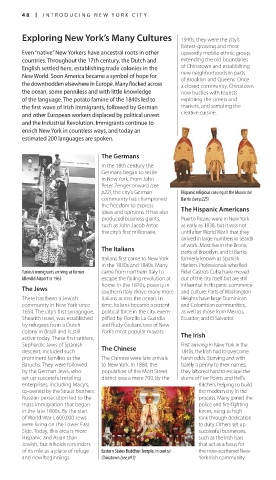
p22), the city’s German Hispanic religious carving at the Museo del
community has championed Barrio (see p225)
the freedom to express The Hispanic Americans
ideas and opinions. It has also
produced business giants, Puerto Ricans were in New York
such as John Jacob Astor, as early as 1838, but it was not
the city’s first millionaire. until after World War II that they
arrived in large numbers in search
of work. Most live in the Bronx,
The Italians parts of Brooklyn, and El Barrio,
Italians first came to New York formerly known as Spanish
in the 1830s and 1840s. Many Harlem. Professionals who fled
Turkish immigrants arriving at former came from northern Italy to Fidel Castro’s Cuba have moved
Idlewild Airport in 1963 escape the failing revolution at out of the city itself but are still
home. In the 1870s, poverty in influential in Hispanic commerce
The Jews southern Italy drove many more and culture. Parts of Washington
There has been a Jewish Italians across the ocean. In Heights have large Dominican
community in New York since time, Italians became a potent and Colombian communities,
1654. The city’s first synagogue, political force in the city, exem- as well as those from Mexico,
Shearith Israel, was established plified by Fiorello La Guardia Ecuador, and El Salvador.
by refugees from a Dutch and Rudy Giuliani, two of New
colony in Brazil and is still York’s most popular mayors.
active today. These first settlers, The Irish
Sephardic Jews of Spanish First arriving in New York in the
descent, included such The Chinese 1840s, the Irish had to overcome
prominent families as the The Chinese were late arrivals harsh odds. Starving and with
Baruchs. They were followed to New York. In 1880, the barely a penny to their names,
by the German Jews, who population of the Mott Street they labored hard to escape the
set up successful retailing district was a mere 700. By the slums of Five Points and Hell’s
enterprises, including Macy’s, Kitchen, helping to build
co-owned by the Straus brothers. the modern city in the
Russian persecution led to the process. Many joined the
mass immigration that began police and fire-fighting
in the late 1800s. By the start forces, rising to high
of World War I, 600,000 Jews rank through dedication
were living on the Lower East to duty. Others set up
Side. Today, this area is more successful businesses,
Hispanic and Asian than such as the Irish bars
Jewish, but it holds reminders that act as a focus for
of its role as a place of refuge Eastern States Buddhist Temple, in central the now-scattered New
and new beginnings. Chinatown (see p91) York Irish community.
048-049_EW_New_York_City.indd 48 4/3/17 11:10 AM

