


Page 53 - Hi-Fi World (January 2020)
P. 53
REVIEW


                without the romance I associate with   I fancied there was a tad
                it.                         more detail but then
                   With classical DSD tracks like   there was less
                Dejan Lazic playing Brahms' 'Piano   low-end drive,
                Concerto No3' although there   David Bowie's
                was fabulous insight - the almost   'Suffragette City'
                relentless clarity of this DAC made   missing a bit of
                for a lack of organic warmth that   propulsive power. So a
                was not what I expect from DSD.   bit of a compromise here
                Again though, the tremendous sense   but do-able all the same.
                of timing and broad sound stage      Headphones are best used at   Our DIY loudspeaker adaptor
                gave Hugo TT2 a sense of rigid   Lo gain that limits output to 3V   leads, XLR to 4mm line socket
                composure no other DAC can match,   – more than enough. Sound quality   (not available commercially; go
                strings coming through with assured   showed all the traits I heard with   to RS Components).
                presence.                   loudspeakers, cross-feed (XFeed)
                   After writing the above I was   making the experience less in-head.   peculiarly tight yet punchy bass. It is
                told Hugo TT2 converts DSD to                            a little short on warmth, especially
                PCM, presumably because the   CONCLUSION                 with DSD, majoring on deep analysis
                custom FPGA chip lacks a DSD   Hugo TT2 resolves both CD and hi-  instead – undoubtedly its forte.
                process route with low pass filter.   res digital with breathtaking clarity,      To hear CD and hi-res like you’ve
                This explains what I heard though.  giving a starkly clear and concise   never heard it before, and as you will
                   With hi-res classical such as   sound unmatched elsewhere. It   not hear it anywhere else, this is the
                the Minnesota Orchestra playing   also has fantastic timing and almost   DAC to audition.
                Korsakov’s 'Dance of the Tumblers'
                from 'The Snow Maiden' (24/96),
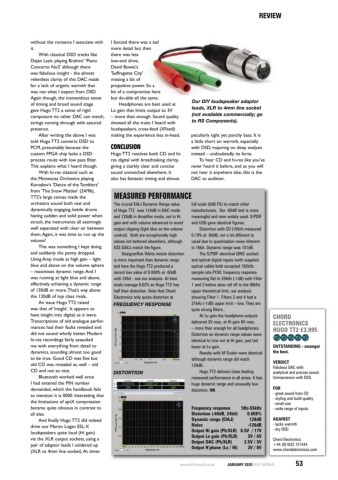
                TT2's large canvas made the   MEASURED PERFORMANCE
                orchestra sound both vast and   The crucial EIAJ Dynamic Range value   full scale (0dB FS) to match other
                dynamically engaging, kettle drums   of Hugo TT2  was 124dB in DAC mode   manufacturers.  Our -60dB test is more
                having sudden and solid power when   and 128dB in Amplifier mode, set to Hi   meaningful and now widely used. S/PDIF
                struck, the instruments all seemingly   gain and with volume advanced to avoid   and USB gave identical figures.
                well separated with clear air between   output clipping (light blue on the volume      Distortion with CD (16bit) measured
                them. Again, it was time to run up the   control).  Both are exceptionally high   0.19% at -60dB, not a lot different to
                volume!                       values not bettered elsewhere, although   usual due to quantisation noise inherent
                   This was something I kept doing   ESS DACs match the figure.   in 16bit. Dynamic range was 101dB.
                and suddenly the penny dropped.      DesignerRob Watts insists distortion      The S/PDIF electrical (BNC socket)
                Using Amp mode at high gain – light   is more important than dynamic range   and optical digital inputs (with supplied
                blue and above on the volume sphere   and here the Hugo TT2 produced a   optical cable) both accepted 192kHz
                – maximises dynamic range. And I   record low value of 0.008% at -60dB   sample rate PCM, frequency response
                was running at light blue and above,   with 24bit - see our analysis. At best   measuring flat to 55kHz (-1dB) with Filter
                effectively achieving a dynamic range   rivals manage 0.02% so Hugo TT2 has   1 and 3 before slow roll off to the 96kHz
                of 130dB or more. That’s way above   half their distortion. Note that Chord   upper theoretical limit, our analysis
                the 120dB of top class rivals.   Electronics only quote distortion at   showing Filter 1. Filters 2 and 4 had a
                   An issue Hugo TT2 raised   FREQUENCY RESPONSE         21kHz (-1dB) upper limit – low. They are
                was that of ‘insight’. It appears to                     quite strong filters..
                have insight into digital, as it were.                      At Lo gain the headphone outputs   CHORD
                Transcriptions of old analogue perfor-                   delivered 3V max, at Hi gain 8V max.   ELECTRONICS
                mances had their faults revealed and                     – more than enough for all headphones.   HUGO TT2 £3,995
                did not sound wholly better. Modern                      Distortion an dynamic range values were
                hi-res recordings fairly assaulted                       identical to Line out at Hi gain, just tad
                me with everything from detail to                        lower at Lo gain.            OUTSTANDING - amongst
                dynamics, sounding almost too good                          Results with M Scaler were identical   the best.
                to be true. Good CD was fine but                         although dynamic range did reach
                old CD was revealed as, well – old                       129dB.                       VERDICT
                                                                                                      Fabulous DAC with
                CD and not so nice.          DISTORTION                     Hugo TT2 delivers class leading   analytical and precise sound.
                   Bluetooth worked well once                            measured performance in all areas. It has   Unimpressive with DSD.
                I had entered the PIN number                             huge dynamic range and unusually low
                demanded, which the handbook fails                       distortion. NK               FOR
                to mention: it is 0000. Interesting that                                              - great sound from CD
                the limitations of aptX compression                                                   - styling and build quality
                                                                                                      - small size
                became quite obvious in contrast to                      Frequency response    5Hz-55kHz  - wide range of inputs
                all else.                                                Distortion (-60dB, 24bit)   0.008%
                   And finally Hugo TT2 did indeed                       Dynamic range (EIAJ)   128dB  AGAINST
                drive our Martin Logan ESL-X                             Noise               -126dB   - lacks warmth
                                                                                                      - dry DSD
                loudspeakers quite loud (Hi gain)                        Output Hi gain (Ph/XLR)   8.5V  / 17V
                                                                                              3V / 6V
                via the XLR output sockets, using a                      Output Lo gain (Ph/XLR)     2.5V / 5V  Chord Electronics
                                                                         Output DAC (Ph/XLR)
                pair of adaptor leads I soldered up                      Output H’phone (Lo / Hi)   3V / 8V  +44 (0)1622 721444
                (XLR to 4mm line socket). At times                                                    www.chordelectronics.com
                                                                     www.hi-fiworld.co.uk   JANUARY 2020 HI-FI WORLD   53

