


Page 95 - Hi-Fi World (January 2020)
P. 95
REVIEW


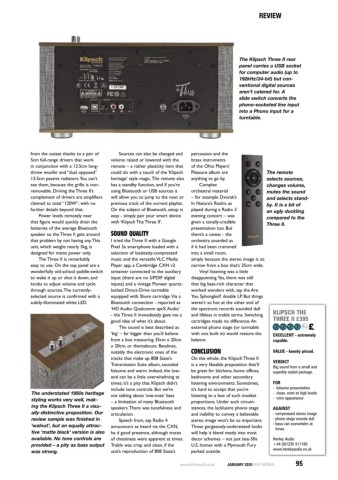
                                                                                          The Klipsch Three II rear
                                                                                          panel carries a USB socket
                                                                                          for computer audio (up to
                                                                                          192kHz/24-bit) but con-
                                                                                          ventional digital sources
                                                                                          aren’t catered for. A
                                                                                          slide switch converts the
                                                                                          phono-socketed line input
                                                                                          into a Phono input for a
                                                                                          turntable.


                from the outset thanks to a pair of      Sources can also be changed and   percussion and the
                5cm full-range drivers that work   volume raised or lowered with the   brass instruments
                in conjunction with a 13.5cm long-  remote – a rather plasticky item that   of the Ohio Players’
                throw woofer and “dual opposed”   could do with a touch of the ‘Klipsch   Pleasure album are   The remote
                13.5cm passive radiators. You can’t   heritage’ style magic. The remote also   anything to go by.   selects sources,
                see them, because the grille is non-  has a standby function, and if you’re      Complex   changes volume,
                removable. Driving the Three II’s   using Bluetooth or USB sources it   orchestral material   mutes the sound
                complement of drivers are amplifiers   will allow you to jump to the next or   – for example Dvorak’s   and selects stand-
                claimed to total “120W”, with no   previous track of the current playlist.   In Nature’s Realm, as   by. It is a bit of
                further details beyond that.  On the subject of Bluetooth, setup is   played during a Radio 3   an ugly duckling
                   Power levels remotely near   easy - simply pair your smart device   evening concert – was   compared to the
                that figure would quickly drain the   with ‘Klipsch The Three II’.  given a tonally-credible   Three II.
                batteries of the average Bluetooth                       presentation too. But
                speaker so the Three II gets around   SOUND QUALITY      there’s a caveat - the
                that problem by not having any. This   I tried the Three II with a Google   orchestra sounded as
                unit, which weighs nearly 5kg, is   Pixel 3a smartphone loaded with a   if it had been crammed
                designed for mains power only.  selection of losslessly-compressed   into a small room,
                   The Three II is remarkably   music and the versatile VLC Media   simply because the stereo image is so
                easy to use. On the top panel are a   Player app, a Cambridge CXN v2   narrow from a box that’s 35cm wide.
                wonderfully old-school paddle-switch   streamer connected to the auxiliary      Vinyl listening was a little
                to wake it up or shut it down, and   input (there are no S/PDIF digital   disappointing. Yes, there was still
                knobs to adjust volume and cycle   inputs) and a vintage Pioneer quartz-  that big bass-rich character that
                through sources. The currently-  locked Direct-Drive turntable   worked wonders with, say, the Are
                selected source is confirmed with a   equipped with Shure cartridge. Via a   You Sphongled? double LP. But things
                subtly-illuminated white LED.   Bluetooth connection - reported as   weren’t so hot at the other end of
                                            ‘HD Audio: Qualcomm aptX Audio’   the spectrum; records sounded dull
                                            - the Three II immediately gave me a   and lifeless in treble terms. Switching   KLIPSCH THE
                                            good idea of what it’s about.  cartridges made no difference. An   THREE II £395
                                               The sound is best described as   external phono stage (or turntable   £
                                            ‘big’ – far bigger than you’d believe   with one built in) would restore the   EXCELLENT - extremely
                                            from a box measuring 35cm x 20cm   balance.               capable.
                                            x 20cm, or thereabouts. Basslines,
                                            notably the electronic ones of the   CONCLUSION           VALUE - keenly priced.
                                            tracks that make up 808 State’s   On the whole, the Klipsch Three II
                                            Transmission Suite album, sounded   is a very likeable proposition that’ll   VERDICT
                                                                                                      Big sound from a small and
                                            fulsome and warm. Indeed, the low-  be great for kitchens, home offices,   superbly-styled package.
                                            end can be a little overwhelming at   bedrooms and other secondary
                                            times; it’s a pity that Klipsch didn’t   listening environments. Sometimes,   FOR
                                            include tone controls. But we’re   it’s hard to accept that you’re   -  fulsome presentation
                The understated 1950s heritage   not talking about ‘one-note’ bass   listening to a box of such modest   -  clean, even at high levels
                styling works very well, mak-  – a limitation of many Bluetooth   proportions. Under such circum-  -  retro appearance
                ing the Klipsch Three II a visu-  speakers. There was tunefulness and   stances, the lacklustre phono stage   AGAINST
                ally-distinctive proposition. Our   articulation.        and inability to convey a believable   - compressed stereo image
                review sample was finished in      Speech from, say, Radio 4   stereo image won’t be so important.   - phono stage sounds dull
                ‘walnut’, but an equally attrac-  announcers as heard via the CXN,   Those gorgeously-understated looks   - bass can overwhelm at
                tive ‘matte black’ version is also   ha d good presence, although traces   will help it blend neatly into most     times
                available. No tone controls are   of chestiness were apparent at times.   decor schemes – not just late-50s   Henley Audio
                provided – a pity as bass output   Treble was crisp and clean, if the   U.S. homes with a Plymouth Fury   +44 (0)1235 511166
                was strong.                 unit’s reproduction of 808 State’s   parked outside.      www.henleyaudio.co.uk

                                                                     www.hi-fiworld.co.uk   JANUARY 2020 HI-FI WORLD   95

