


Page 54 - (DK Eyewitness) Travel Guide - Cuba
P. 54
52 ❯❯ The Top 10 of Everything
Animals and Birds
Solenodon
4
You are unlikely to see one
of these longnosed, anteating
mam mals in the wild, as they are
shy and nocturnal. Resembling a
giant shrew, the solenodon is an
endangered species, as it is easy
prey for dogs and mongooses.
Tocororo
5
This pigeonsized, forest
dwelling bird is a member of the
trogon family. The tocororo is Cuba’s
national bird because its blue, white,
and red plumage corresponds to the
colors of the nation’s flag. It has a
serrated bill, concavetipped tail, and
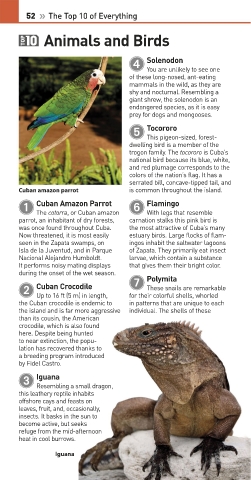
Cuban amazon parrot is common throughout the island.
Cuban Amazon Parrot
Flamingo
1 6
The cotorra, or Cuban amazon
With legs that resemble
parrot, an inhabitant of dry forests, carnation stalks this pink bird is
was once found throughout Cuba. the most attractive of Cuba’s many
Now threatened, it is most easily estuary birds. Large flocks of flam
seen in the Zapata swamps, on ingos inhabit the saltwater lagoons
Isla de la Juventud, and in Parque of Zapata. They primarily eat insect
Nacional Alejandro Humboldt. larvae, which contain a sub stance
It performs noisy mating dis plays that gives them their bright color.
during the onset of the wet season. Polymita
Cuban Crocodile
2 7
These snails are remarkable
for their colorful shells, whorled
Up to 16 ft (5 m) in length,
the Cuban crocodile is endemic to in patterns that are unique to each
the island and is far more aggressive individual. The shells of these
than its cousin, the American
crocodile, which is also found
here. Despite being hunted
to near extinction, the popu
lation has recovered thanks to
a breeding program intro duced
by Fidel Castro.
Iguana
3
Resembling a small dragon,
this leathery reptile inhabits
offshore cays and feasts on
leaves, fruit, and, occasionally,
insects. It basks in the sun to
become active, but seeks
refuge from the midafternoon
heat in cool burrows.
Iguana
052-053_Top_10_Cuba.indd 52 27/06/2016 15:50

