


Page 131 - (DK Eyewitness) Travel Guide - Sardinia
P. 131
THE WESTERN C O AST 129
Here, a turning to the right
leads to the entrance to the
archaeological site, which
is fenced off. Together with
the monuments at Barùmini
(see pp68–9) and Torralba
(see pp28–9), this nuraghic
complex is one of the
most important remaining
from the immediate pre-
Punic period.
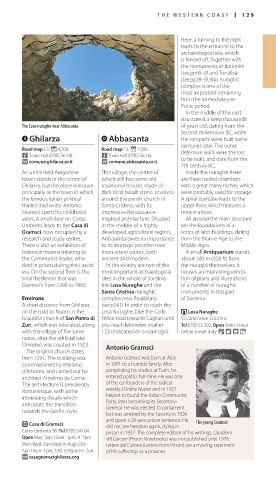
In the middle of this vast
structure is a keep thousands
The Losa nuraghe near Abbasanta of years old, dating from the
second millennium BC, while
q Ghilarza w Abbasanta the ramparts were built some
centuries later. The outer
Road map C3. * 4,700. Road map C3. * 2,700.
n Town Hall (0785 56 10). n Town Hall (0785 56 16). defensive walls were the last
∑ comune.ghilarza.or.it ∑ comune.abbasanta.or.it to be built, and date from the
7th century BC.
An unfinished Aragonese This village, the centre of Inside the nuraghe there
tower stands in the centre of which still has some old are three roofed chambers
Ghilarza, but the place is known traditional houses made of with a great many niches, which
principally as the town in which dark local basalt stone, revolves were probably used for storage.
the famous Italian political around the parish church of A spiral staircase leads to the
thinker and writer Antonio Santa Cristina, with its upper floor, which features a
Gramsci spent his childhood impressive Renaissance- terrace above.
years. A small door on Corso inspired architecture. Situated All around the main structure
Umberto leads to the Casa di in the middle of a highly are the foundations of a
Gramsci, now occupied by a developed agricultural region, series of later buildings, dating
research and study centre. Abbasanta owes its impor tance from the Bronze Age to the
There is also an exhibition of to its strategic position near Middle Ages.
historical material relating to main artery routes, both A small Antiquarium stands
the Communist leader, who ancient and modern. about 100 m (328 ft) from
died in prison during the Fascist In the vicinity are two of the the nuraghi themselves. It
era. On the second floor is the most important archaeo logical houses an interesting exhibi-
small bedroom that was sites in the whole of Sardinia: tion of plans and illustrations
Gramsci’s from 1898 to 1908. the Losa Nuraghe and the of a number of nuraghic
Santa Cristina nuraghic monu ments in this part
Environs complex near Paulilàtino of Sardinia.
A short distance from Ghilarza, (see p141). In order to reach the
on the road to Nuoro, is the Losa Nuraghe, take the Carlo T Losa Nuraghe
beautiful church of San Pietro di Felice road towards Cagliari until SS Carlo Felice 123.5 km.
Zuri, which was relocated, along you reach kilometre marker Tel 0785 52 302. Open 9am–1 hour
with the village of the same 123 (indicated on a road sign). before sunset daily. & 8 - =
name, after the artificial lake
Omodeo was created in 1923. Antonio Gramsci
The original church dates
from 1291. The building was Antonio Gramsci was born at Àles
commissioned by Mariano in 1891 to a humble family. After
d’Arborea, and carried out by completing his studies at Turin, he
architect Anselmo da Como. entered politics full-time. He was one
The architecture is prevalently of the co-founders of the radical
Romanesque, with some weekly L’Ordine Nuovo and in 1921
interesting details which helped to found the Italian Communist
anticipate the transition Party, later becoming its Secretary-
General. He was elected to parliament
towards the Gothic style.
but was arrested by the Fascists in 1926
and given a 20-year prison sentence. He
E Casa di Gramsci did not see freedom again, dying in The young Gramsci
Corso Umberto 36. Tel 0785 541 64. prison in 1937. The complete edition of his writings, Quaderni
Open May–Sep: 10am–1pm, 4–7pm del Carcere (Prison Notebooks) was not published until 1976.
Mon, Wed–Sun (daily in Aug); Oct– Lettere dal Carcere (Letters from Prison) are a moving statement
Apr: 10am–1pm, 3:30–6:30pm Fri–Sun. of his sufferings as a prisoner.
∑ casagramscighilarza.org
128-129_EW_Sardinia.indd 129 11/2/16 2:12 PM

