


Page 136 - (DK Eyewitness) Travel Guide - Sardinia
P. 136
134 SARDINIA AREA B Y AREA
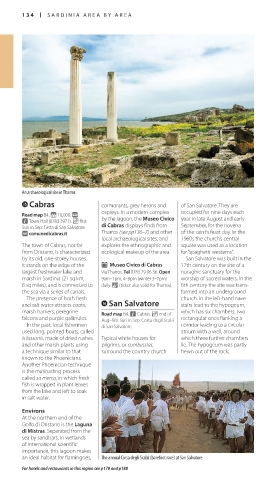
An archaeological site in Tharros
t Cabras cormorants, grey herons and of San Salvatore. They are
ospreys. In a modern complex occupied for nine days each
Road map B4. * 10,000. @
n Town Hall (0783 3971). _ first by the lagoon, the Museo Civico year in late August and early
Sun in Sep: Festa di San Salvatore. di Cabras displays finds from September, for the novena
∑ comunedicabras.it Tharros (see pp136–7) and other of the saint’s feast day. In the
local archaeological sites, and 1960s the church’s central
The town of Cabras, not far explores the ethnographic and square was used as a location
from Oristano, is characterized ecological makeup of the area. for “spaghetti westerns”.
by its old, one-storey houses. San Salvatore was built in the
It stands on the edge of the E Museo Civico di Cabras 17th century on the site of a
largest freshwater lake and Via Tharros. Tel 0783 29 06 36. Open nuraghic sanctuary for the
marsh in Sardinia (21 sq km, 9am–1pm, 4–8pm (winter 3–7pm) worship of sacred waters. In the
8 sq miles), and is connected to daily. & (ticket also valid for Tharros). 6th century the site was trans-
the sea via a series of canals. formed into an under ground
The presence of both fresh church. In the left-hand nave
and salt water attracts coots, y San Salvatore stairs lead to the hypo geum,
marsh harriers, peregrine Road map B4. n Cabras. _ end of which has six chambers: two
falcons and purple gallinules. Aug–first Sun in Sep: Corsa degli Scalzi rectangular ones flanking a
In the past, local fishermen di San Salvatore. corridor leading to a circular
used long, pointed boats, called atrium with a well, around
is fassonis, made of dried rushes Typical white houses for which three further chambers
and other marsh plants using pilgrims, or cumbessias, lie. The hypogeum was partly
a technique similar to that surround the country church hewn out of the rock;
known to the Phoenicians.
Another Phoenician technique
is the marinading process
called sa merca, in which fresh
fish is wrapped in plant leaves
from the lake and left to soak
in salt water.
Environs
At the northern end of the
Golfo di Oristano is the Laguna
di Mistras. Separated from the
sea by sandbars, in wetlands
of international scientific
importance, this lagoon makes
an ideal habitat for flamingoes, The annual Corsa degli Scalzi (barefoot race) at San Salvatore
For hotels and restaurants in this region see p178 and p188
134-135_EW_Sardinia.indd 134 11/2/16 2:12 PM

