


Page 143 - (DK Eyewitness) Travel Guide - Sardinia
P. 143
THE WESTERN C O AST 141
centre consists of houses in red
and grey stone. One of the best
preserved is Casa Madeddu, a
typical old “Aragonese house”
of the early 1600s with Catalan-
style doorways and windows.
On the same street is the 16th
century parish church of San
Pietro Apostolo, in red trachyte,
which has been almost entirely
rebuilt. The Roman Baths lie on
the banks of the river, with a
fine portico and several rooms Village of Àles at the foot of Monte Arci
with mosaic pavements. The
rectangular pool still contains encloses the archaeological f Àles
warm water from the hot springs. area, where there is a well Road map C4. * 1,700. n Town
A short distance south of temple dedicated to the local Hall (0783 91 131). _ first Sun in Aug:
Fordon gianus stands the rural mother -goddess dating from Santa Madonna della Neve.
church of San Lussorio, the 1st millennium BC. The well ∑ comune.ales.or.it
built by Victorine is in a good state of
monks around AD preservation, and a Àles, the main village in the
1100, over an early broad stone stairway Marmilla area, lies on the eastern
Christian crypt. leads to its vaulted slope of Monte Arci. In the upper
under ground chamber. part stands the cathedral of San
T Roman Baths Earrings found at the Nearby is an enclosure Pietro, built in 1686 by Genoan
Via Terme. Tel 0783 60 Forum Traiani that was probably used architect Domenico Spotorno,
157. Open 9:30am–1pm, for general assemblies. who used the ruins of the 12th -
3–6:30pm daily. & The sacred nature of this site century church on this site as
has been maintained over the material for his construction.
centuries with the construc tion Twin bell towers with ceramic
d Paulilàtino of a church dedicated to Santa domes rise above the elegant
Cristina. Worshippers continue façade, while in the Baroque
Road map C4. * 2,500. n Viale
della Libertà 33 (0785 556 23). to flock to the church, which interior, the sacristy has lovely
_ second Sun in May: Sagra di is surrounded by muristenes, carved furniture and a rare
Santa Cristina. houses intended for those 14th-century crucifix. The
who come here for novena Archivio Capitolare contains
This rural village at the edge of on the saint’s feast day. elegant gold jewellery.
the Abbasanta basalt plateau is To the right of the church, In the same square stand
surrounded by olive groves and among the olive trees, another the Palazzo Vescovile and the
cork oak woods. The houses are archaeological zone includes a seminary and oratory of the
built of dark stone and have well-preserved nuraghe and Madonna del Rosario.
Aragonese doorways and small two rectangular nuraghic-age Àles is also the birthplace of
wrought-iron balconies. The stone dwellings. The best Antonio Gramsci (1891–1937)
same stone was used to build preserved of these is 14 m (see p129). The house is marked
the church of San Teodoro (46 ft) long and 2 m (6 ft) high. with a plaque.
in the 17th century. This
Aragonese Gothic church has a T Santa Cristina Environs
stained-glass rose window and a Km 114,300, SS131 Cagliari-Sassari. Àles is a good starting point for
bell tower with an onion dome. n Cooperativa Archeotour (0785 a hike to the top of Trebina
Palazzo Atzori houses a museum 554 38). Open 8:30am–dusk. Longa and Trebina Lada, the
of folk culture with domestic highest peaks on Monte Arci,
tools and objects on display. the remnants of an ancient
crater. Along the way you are
P Palazzo Atzori likely to spot pieces of obsidian,
Via Nazionale 127. Tel 0785 554 38. the hard black volcanic glass
Open summer: 9:30am–1pm, 4–7pm; which was cut into thin slices
winter: 9:30am–1pm, 3–5:30pm. and used to make arrow heads,
Closed Mon. & 8 7 spears and scrapers. The
obsidian of Monte Arci was in
Environs great demand, and not only
About 4 km (3 miles) from town, supplied the whole of Sardinia,
a turning off state road 131 takes but was also sold throughout
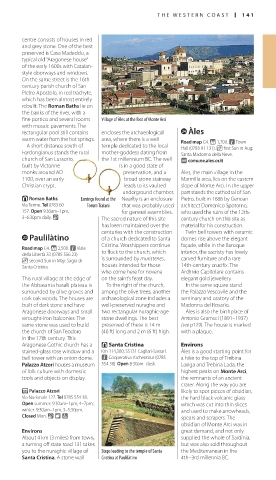
you to the nuraghic village of Steps leading to the temple of Santa the Mediterranean in the
Santa Cristina. A stone wall Cristina at Paulilàtino 4th–3rd millennia BC.
140-141_EW_Sardinia.indd 141 11/2/16 12:13 PM

