


Page 138 - (DK Eyewitness) Travel Guide - Sardinia
P. 138
136 SARDINIA AREA B Y AREA
i Tharros
The city of Tharros was founded by the Phoenicians around
the end of the 8th century BC, on a spit of land called Capo
San Marco, which offered safe anchorage for cargo-laden
ships. By the 6th and 5th centuries BC, Tharros had become
a flourishing port and this prosperity continued under the
Romans, from 238 BC on. With sea on two sides, this is one of
the most intriguing ancient sites in the Mediterra nean. Only
a third of the area has been unearthed so far. Most of the
visible remains date back to the Punic-Roman era, but there 7th–6th century BC necklace
is also evidence of previous civilizations: the nuraghic village Made of gold and cornelian,
(late Bronze Age) and the Tophet (Phoenician) located on this necklace was found in the
the hill, Su Murru Mannu. southern necropolis.
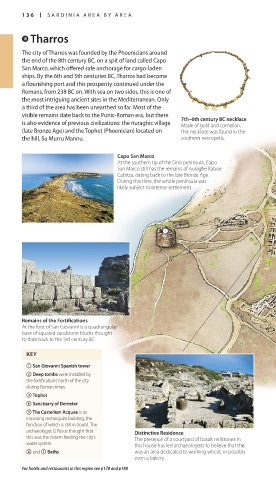
Capo San Marco
At the southern tip of the Sinis penin sula, Capo
San Marco still has the remains of nuraghe Baboe
Cabitza, dating back to the late Bronze Age.
During this time, the whole peninsula was
likely subject to intense settlement.
Remains of the Fortifications
At the foot of San Giovanni is a quadrangular
base of squared sandstone blocks thought
to date back to the 3rd century BC.
KEY
1 San Giovanni Spanish tower
2 Deep tombs were installed by
the fortifications north of the city
during Roman times.
3 Tophet
4 Sanctuary of Demeter
5 The Castellum Acquae is an
imposing rectangu lar building, the
function of which is still in doubt. The
archaeologist G Pesce thought that Distinctive Residence
this was the cistern feeding the city’s The presence of a courtyard of basalt millstones in
water system. this house has led archaeologists to believe that this
6 and 7 Baths was an area dedicated to working wheat, or possibly
even a bakery.
For hotels and restaurants in this region see p178 and p188
136-137_EW_Sardinia.indd 136 11/2/16 2:12 PM

