


Page 149 - (DK Eyewitness) Travel Guide - Sardinia
P. 149
THE NOR TH AND THE C OST A SMER ALD A 147
The Porto Rotondo quay and
Piazzetta San Marco are lined
with famous designer shops,
and throughout the summer
the cafés and restaurants are
crowded with visitors, lunch ing,
dining, meeting friends, or just
watching the world go by. Out
of season Porto Rotondo is
quiet and even deserted.
The church of San Lorenzo,
designed by Andrea Cascella,
holds pretty wooden statues
by Mario Ceroli depicting
Biblical figures.
Just outside Porto Rotondo
is the attractive headland
called Punta della Volpe, which
separates the Golfo di Marinella
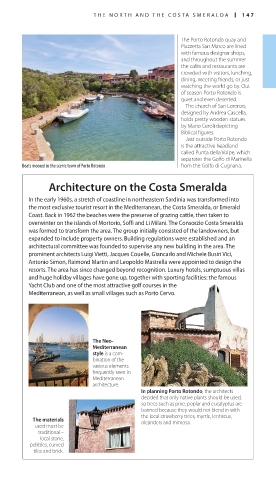
Boats moored in the scenic town of Porto Rotondo from the Golfo di Cugnana.
Architecture on the Costa Smeralda
In the early 1960s, a stretch of coastline in north eastern Sardinia was transformed into
the most exclusive tourist resort in the Mediterranean, the Costa Smeralda, or Emerald
Coast. Back in 1962 the beach es were the preserve of grazing cattle, then taken to
overwinter on the islands of Mortorio, Soffi and Li Milani. The Consorzio Costa Smeralda
was formed to transform the area. The group initially consisted of the landowners, but
ex panded to include property owners. Building regulations were established and an
architectural committee was founded to supervise any new building in the area. The
prominent architects Luigi Vietti, Jacques Couelle, Giancar lo and Michele Busiri Vici,
Antonio Si mon, Raimond Martin and Leopoldo Mastrella were appointed to design the
resorts. The area has since changed be yond recognition. Luxury hotels, sump tuous villas
and huge holiday villages have gone up, together with sporting facilities: the famous
Yacht Club and one of the most attractive golf courses in the
Mediterranean, as well as small villages such as Porto Cervo.
The Neo-
Mediterranean
style is a com
bination of the
various elements
frequently seen in
Mediterranean
architecture.
In planning Porto Rotondo, the architects
decided that only native plants should be used,
so trees such as pine, poplar and eucalyptus are
banned because they would not blend in with
the local strawberry trees, myrtle, lentiscus,
The materials oleanders and mimosa.
used must be
traditional –
local stone,
pebbles, curved
tiles and brick.
146-147_EW_Sardinia.indd 147 11/2/16 2:12 PM

