


Page 171 - (DK Eyewitness) Travel Guide - Sardinia
P. 171
THE NOR TH AND THE C OST A SMER ALD A 169
given its name (“red island”)
after the small, reddish-
coloured rock island out in
the bay. Fishing boats are
drawn up on the beach below
the village after each day’s
catch is brought in.
The coastline either side of
Isola Rossa is worth visiting,
especially towards the east,
where Monte Tinnari overlooks
the sea. To the west, the coast
gently slopes to meet the
mouth of the Rio Coghina, a
short distance from Castelsardo.
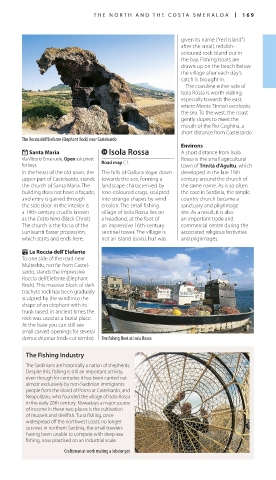
The Roccia dell’Elefante (Elephant Rock) near Castelsardo
Environs
R Santa Maria f Isola Rossa A short distance from Isola
Via Vittorio Emanuele. Open ask priest Road map C1. Rossa is the small agricultural
for keys. town of Trinità d’Agultu, which
In the heart of the old town, the The hills of Gallura slope down developed in the late 19th
upper part of Castelsardo, stands towards the sea, forming a century around the church of
the church of Santa Maria. The landscape charac terized by the same name. As is so often
building does not have a façade, rose-coloured crags, sculpted the case in Sardinia, the simple
and entry is gained through into strange shapes by wind country church became a
the side door. In the interior is erosion. The small fishing sanctuary and pilgrimage
a 14th-century crucifix known village of Isola Rossa lies on site. As a result, it is also
as the Cristo Nero (Black Christ). a headland, at the foot of an important trade and
The church is the focus of the an impressive 16th-century commercial centre during the
Lunissanti Easter procession, sentinel tower. The village is associated religious festivities
which starts and ends here. not an island (isola), but was and pilgrimages.
} La Roccia dell’Elefante
To one side of the road near
Multeddu, not far from Castel-
sardo, stands the impressive
Roccia dell’Elefante (Elephant
Rock). This massive block of dark
trachyte rock has been gradually
sculpted by the wind into the
shape of an elephant with its
trunk raised. In ancient times the
rock was used as a burial place.
At the base you can still see
small carved openings for several
domus de janas (rock-cut tombs). The fishing fleet at Isola Rossa
The Fishing Industry
The Sardinians are historically a nation of shepherds.
Despite this, fishing is still an important activity,
even though for centuries it has been carried out
almost exclusively by non-Sardinian immigrants:
people from the island of Ponza at Castelsardo, and
Neapolitans, who founded the village of Isola Rossa
in the early 20th century. Nowadays a major source
of income in these two places is the cultivation
of mussels and shellfish. Tuna fishing, once
widespread off the northwest coast, no longer
survives in northern Sardinia, the small trawlers
having been unable to compete with deep-sea
fishing, now practised on an industrial scale.
Craftsman at work making a lobster pot
168-169_EW_Sardinia.indd 169 11/2/16 2:13 PM

