


Page 166 - (DK Eyewitness) Travel Guide - Sardinia
P. 166
164 SARDINIA AREA B Y AREA
s Sassari mythical and monstrous
animals, while the interior was
Sardinia’s second most important city commercially, politically rebuilt in the Gothic style.
and culturally, Sassari lies on a tableland that slopes down to the In the late 18th century grand
sea among olive groves and well cultivated valleys. The city has decorations were added to the
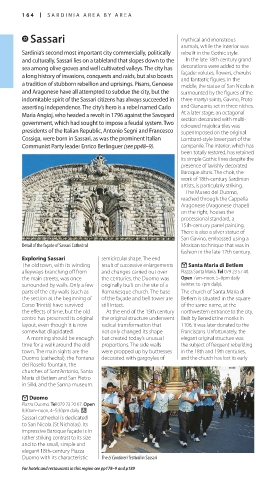
a long history of invasions, conquests and raids, but also boasts façade: volutes, flowers, cherubs
and fantastic figures. In the
a tradition of stubborn rebellion and uprisings. Pisans, Genoese middle, the statue of San Nicola is
and Aragonese have all attempted to subdue the city, but the surmounted by the figures of the
indomitable spirit of the Sassari citizens has always succeeded in three martyr saints, Gavino, Proto
asserting independence. The city’s hero is a rebel named Carlo and Gianuario, set in three niches.
Maria Angioj, who headed a revolt in 1796 against the Savoyard At a later stage, an octagonal
section decorated with multi-
government, which had sought to impose a feudal system. Two coloured majolica tiles was
presidents of the Italian Republic, Antonio Segni and Francesco superimposed on the original
Cossiga, were born in Sassari, as was the prominent Italian Lombard-style lower part of the
Communist Party leader Enrico Berlinguer (see pp48–9). campanile. The interior, which has
been totally restored, has retained
its simple Gothic lines despite the
presence of lavishly decorated
Baroque altars. The choir, the
work of 18th-century Sardinian
artists, is particularly striking.
The Museo del Duomo,
reached through the Cappella
Aragonese (Aragonese chapel)
on the right, houses the
processional standard, a
15th-century panel painting.
There is also a silver statue of
San Gavino, embossed using a
Detail of the façade of Sassari Cathedral Mexican technique that was in
fashion in the late 17th century.
Exploring Sassari semicircular shape. The end
The old town, with its winding result of successive enlarge ments R Santa Maria di Betlem
alleyways branching off from and changes carried out over Piazza Santa Maria. Tel 079 23 57 40.
the main streets, was once the centuries, the Duomo was Open 7am–noon, 5–8pm daily
surrounded by walls. Only a few originally built on the site of a (winter: to 7pm daily).
parts of the city walls (such as Romanesque church. The base The church of Santa Maria di
the section at the beginning of of the façade and bell tower are Betlem is situated in the square
Corso Tri nità) have survived still intact. of the same name, at the
the effects of time, but the old At the end of the 15th century northwestern entrance to the city.
centre has preserved its original the original structure underwent Built by Benedictine monks in
layout, even though it is now radical transforma tion that 1106, it was later donated to the
somewhat dilapidated. not only changed its shape Franciscans. Unfortunately, the
A morning should be enough but created today’s unusual elegant original structure was
time for a walk around the old proportions. The side walls the subject of frequent rebuilding
town. The main sights are the were propped up by buttresses in the 18th and 19th centuries,
Duomo (cathedral), the Fontana decorated with gargoyles of and the church has lost its early
del Rosello fountain, the
churches of Sant’Antonio, Santa
Maria di Betlem and San Pietro
in Silki, and the Sanna museum.
R Duomo
Piazza Duomo. Tel 079 23 20 67. Open
8:30am–noon, 4–5:30pm daily. 7
Sassari cathedral is dedicated
to San Nicola (St Nicholas). Its
impressive Baroque façade is in
rather striking contrast to its size
and to the small, simple and
elegant 18th-century Piazza
Duomo with its characteristic The Li Candareri festival in Sassari
For hotels and restaurants in this region see pp178–9 and p189
164-165_EW_Sardinia.indd 164 11/2/16 2:12 PM

