


Page 104 - (DK) Super Shark Encyclopedia: And Other Creatures of the Deep
P. 104
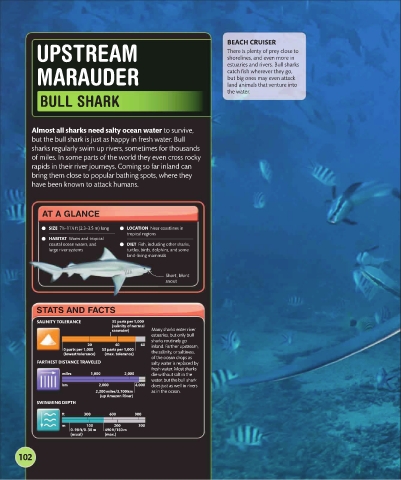
UPSTREAM                                                            BEACH CRUISER
                                                                                  There is plenty of prey close to
                                                                                  shorelines, and even more in
              MARAUDER                                                            estuaries and rivers. Bull sharks
                                                                                  catch fish wherever they go,
                                                                                  but big ones may even attack
                                                                                  land animals that venture into
                                                                                  the water.
               BULL SHARK


            Almost all sharks need salty ocean water to survive,
            but the bull shark is just as happy in fresh water. Bull
            sharks regularly swim up rivers, sometimes for thousands
            of miles. In some parts of the world they even cross rocky
            rapids in their river journeys. Coming so far inland can
            bring them close to popular bathing spots, where they
            have been known to attack humans.


                AT A GLANCE


                •  SIZE  7½–11½ ft (2.3–3.5 m) long  •  LOCATION  Near coastlines in
                •  HABITAT  Warm and tropical   tropical regions
                  coastal ocean waters, and    •  DIET  Fish, including other sharks,
                  large river systems         turtles, birds, dolphins, and some
                                              land-living mammals


                                                            Short, blunt
                                                            snout


              STATS AND FACTS

              SALINITY TOLERANCE         35 parts per 1,000
                                         (salinity of normal
                                         seawater)     Many sharks enter river
                                                       estuaries, but only bull
                                                       sharks routinely go
                                20        40       60  inland. Farther upstream,
                        0 parts per 1,000   53 parts per 1,000   the salinity, or saltiness,
                        (lowest tolerance)  (max. tolerance)
                                                       of the ocean drops as
              FARTHEST DISTANCE TRAVELED               salty water is replaced by
                                                       fresh water. Most sharks
                       miles     1,000       2,000     die without salt in the
                                                       water, but the bull shark
                       km           2,000        4,000  does just as well in rivers
                                   2,300 miles/3,700 km   as in the ocean.
                                     (up Amazon River)
              SWIMMING DEPTH

                       ft      300      600      900
                       m        100       200     300
                          0–98 ft/0–30 m   490 ft/150 m
                          (usual)     (max.)


        102

