


Page 100 - (DK) Super Shark Encyclopedia: And Other Creatures of the Deep
P. 100
REPTILE ON THE ROCKS


             MARINE IGUANA


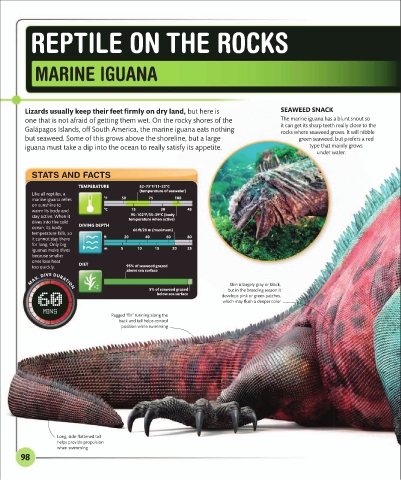
          Lizards usually keep their feet firmly on dry land, but here is                             SEAWEED SNACK
          one that is not afraid of getting them wet. On the rocky shores of the                     The marine iguana has a blunt snout so
                                                                                                     it can get its sharp teeth really close to the
          Galápagos Islands, off South America, the marine iguana eats nothing
                                                                                                     rocks where seaweed grows. It will nibble
          but seaweed. Some of this grows above the shoreline, but a large                                 green seaweed, but prefers a red
          iguana must take a dip into the ocean to really satisfy its appetite.                                type that mainly grows
                                                                                                                  under water.


            STATS AND FACTS

                             TEMPERATURE           52–73°F/11–23°C
                                                   (temperature of seawater)
            Like all reptiles, a
            marine iguana relies      °F    50        75       100
            on sunshine to
            warm its body and         °C        15        30        45
            stay active. When it                95–102°F/35–39°C (body
                                               temperature when active)
            dives into the cold
                             DIVING DEPTH
            ocean, its body
                                                66 ft/20 m (maximum)
            temperature falls, so
                                      ft     20      40     60      80
            it cannot stay there
            for long. Only big
            iguanas make dives        m     5     10    15    20    25
            because smaller
            ones lose heat
                             DIET
            too quickly.                      95% of seaweed grazed
                                              above sea surface
                                                                                   Skin is largely gray or black,
              60                                         below sea surface      develops pink or green patches,
            MAX. DIVE DURATION
                                                      5% of seaweed grazed
                                                                                  but in the breeding season it
                                                                                which may flush a deeper color
                MINS
                                         Ragged “fin” running along the
                                           back and tail helps control
                                            position while swimming


                     Long, side-flattened tail
                     helps provide propulsion
                     when swimming
        98

