


Page 115 - (DK) Super Shark Encyclopedia: And Other Creatures of the Deep
P. 115
MYSTERIOUS


                                                                        GIANT


                                                                          MEGAMOUTH SHARK


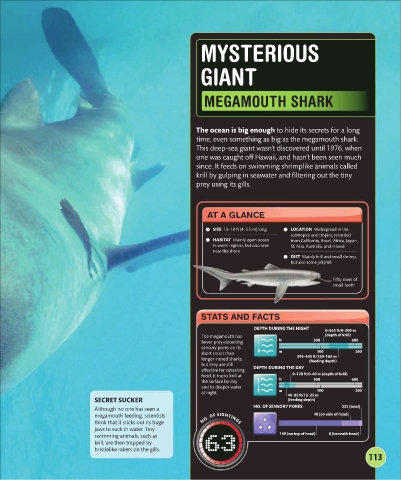
                                                                       The ocean is big enough to hide its secrets for a long
                                                                       time, even something as big as the megamouth shark.
                                                                       This deep-sea giant wasn’t discovered until 1976, when
                                                                       one was caught off Hawaii, and hasn’t been seen much
                                                                       since. It feeds on swimming shrimplike animals called
                                                                       krill by gulping in seawater and filtering out the tiny
                                                                       prey using its gills.


                                                                           AT A GLANCE

                                                                          •  SIZE  13–18 ft (4–5.5 m) long  •  LOCATION  Widespread in the
                                                                          •  HABITAT  Mainly open ocean    subtropics and tropics; recorded
                                                                                                         from California, Brazil, Africa, Japan,
                                                                             in warm regions, but also seen    SE Asia, Australia, and Hawaii
                                                                             near the shore
                                                                                                      •  DIET  Mainly krill and small shrimp,
                                                                                                         but also some jellyfish


                                                                                                                        Fifty rows of
                                                                                                                        small teeth


                                                                         STATS AND FACTS


                                                                                           DEPTH DURING THE NIGHT
                                                                                                                     0–655 ft/0–200 m
                                                                         The megamouth has                           (depth of krill)
                                                                                                    ft           300          600
                                                                         fewer prey-detecting
                                                                         sensory pores on its
                                                                                                    m             100           200
                                                                         short snout than
                                                                                                           395–545 ft/120–165 m
                                                                         longer-nosed sharks,
                                                                                                               (feeding depth)
                                                                         but they are still   DEPTH DURING THE DAY
                                                                         effective for detecting
                                                                                                         0–130 ft/0–40 m (depth of krill)
                                                                         food. It tracks krill at
                                                                                                    ft           300          600
                                                                         the surface by day
                                                                         and to deeper water
                                                                                                    m             100           200
                                                                         at night.
                                                                                                        40–82 ft/12–25 m
                                   SECRET SUCKER                                                        (feeding depth)
                                                                                           NO. OF SENSORY PORES            225 (total)
                                   Although no one has seen a
                                   megamouth feeding, scientists                                                 48 (on side of head)
                                   think that it sticks out its huge     NO. OF SIGHTINGS
                                   jaws to suck in water. Tiny
                                   swimming animals, such as              6 3                        169 (on top of head)  8 (beneath head)
                                   krill, are then trapped by
                                   bristlelike rakers on the gills.
                                                                                                                                    113

