


Page 200 - (DK Eyewitness) Travel Guide - Japan
P. 200
23 "
Ninna-ji
仁和寺
A3 ⌂ 33 Omuro Ouchi,
Ukyo-ku § (075) 461-1155
£ Omuro-Nina-ji Stn,
Keifuku Kitano line @ 10,
EXPERIENCE Kyoto City 4:30pm Dec–Feb)
26, 59 to Omuro Ninna-ji
# 9am–5pm daily (to
Ninna-ji’s colossal front gate
serves as a reminder that this
Shingon-sect temple used to
be, until fires devastated it, a
huge complex numbering up
to 60 subtemples.
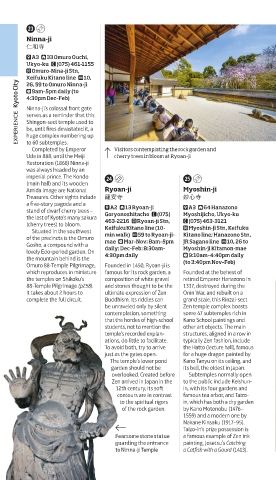
Completed by Emperor Visitors contemplating the rock garden and
Uda in 888, until the Meiji cherry trees in bloom at Ryoan-ji
Restoration (1868) Ninna-ji
was always headed by an
imperial prince. The Kondo
(main hall) and its wooden f " 25 "
Amida image are National Ryoan-ji Myoshin-ji
Treasures. Other sights include 龍安寺 妙心寺
a five-story pagoda and a A2 ⌂ 13 Ryoan-ji A3 ⌂ 64 Hanazono
stand of dwarf cherry trees – Goryonoshitacho § (075) Myoshijicho, Ukyo-ku
the last of Kyoto’s many sakura
(cherry trees) to bloom. 463-2216 £ Ryoan-ji Stn, § (075) 463-3121
Keifuku Kitano line (10-
£ Myoshin-ji Stn, Keifuku
Situated in the southwest min walk) @ 59 to Ryoan-ji- Kitano line; Hanazono Stn,
of the precincts is the Omuro mae # Mar–Nov: 8am–5pm JR Sagano line @ 10, 26 to
Gosho, a compound with a
lovely Edo-period garden. On daily; Dec–Feb: 8:30am– Myoshin-ji Kitamon-mae
4:30pm daily
# 9:10am–4:40pm daily
the mountain behind is the (to 3:40pm Nov–Feb)
Omuro 88-Temple Pilgrimage, Founded in 1450, Ryoan-ji is
which reproduces in miniature famous for its rock garden, a Founded at the behest of
the temples on Shikoku’s composition of white gravel retired Emperor Hanazono in
88-Temple Pilgrimage (p258). and stones thought to be the 1337, destroyed during the
It takes about 2 hours to ultimate expression of Zen Onin War, and rebuilt on a
complete the full circuit. Buddhism. Its riddles can grand scale, this Rinzai-sect
be unraveled only by silent Zen temple com plex boasts
contemplation, something some 47 subtemples rich in
that the hordes of high-school Kano School paintings and
students, not to mention the other art objects. The main
temple’s recorded explan- structures, aligned in a row in
ations, do little to facilitate. typically Zen fashion, include
To avoid both, try to arrive the Hatto (lecture hall), famous
just as the gates open. for a huge dragon painted by
The temple’s lower pond Kano Tanyu on its ceiling, and
garden should not be its bell, the oldest in Japan.
overlooked. Created before Subtemples normally open
Zen arrived in Japan in the to the public include Keishun-
12th century, its soft in, with its four gardens and
contours are in contrast famous tea arbor, and Taizo-
to the spiritual rigors in, which has both a dry garden
of the rock garden. by Kano Motonobu (1476–
1559) and a modern one by
Nakane Kinsaku (1917–95).
Taizo-in’s prize possession is
Fearsome stone statue a famous example of Zen ink
guarding the entrance painting, Josetsu’s Catching
to Ninna-ji Temple a Catfish with a Gourd (1413).
200-201_EW_Japan.indd 200 04/02/2019 15:57
EW Catalogue template v3.0 – 12th July 2018
Fonts: Aptifer Sans LT Pro, Posterama Text, Soho Gothic
Pro, Soho Pro, ITC Caslon 224

