


Page 261 - (DK Eyewitness) Travel Guide - Japan
P. 261
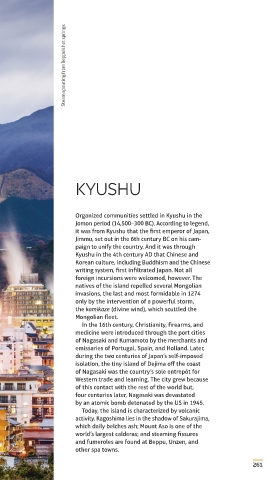
Steam spouting from Beppu’s hot springs
KYUSHU
Organized communities settled in Kyushu in the
Jomon period (14,500–300 BC). According to legend,
it was from Kyushu that the first emperor of Japan,
Jimmu, set out in the 6th century BC on his cam
paign to unify the country. And it was through
Kyushu in the 4th century AD that Chinese and
Korean culture, including Buddhism and the Chinese
writing system, first infiltrated Japan. Not all
foreign incursions were welcomed, however. The
natives of the island repelled several Mongolian
invasions, the last and most formidable in 1274
only by the intervention of a powerful storm,
the kamikaze (divine wind), which scuttled the
Mongolian fleet.
In the 16th century, Christianity, firearms, and
medicine were introduced through the port cities
of Nagasaki and Kumamoto by the merchants and
emissaries of Portugal, Spain, and Holland. Later,
during the two centuries of Japan’s selfimposed
isolation, the tiny island of Dejima off the coast
of Nagasaki was the country’s sole entrepôt for
Western trade and learning. The city grew because
of this contact with the rest of the world but,
four centuries later, Nagasaki was devastated
by an atomic bomb detonated by the US in 1945.
Today, the island is characterized by volcanic
activity. Kagoshima lies in the shadow of Sakurajima,
which daily belches ash; Mount Aso is one of the
world’s largest calderas; and steaming fissures
and fumeroles are found at Beppu, Unzen, and
other spa towns.
261
260-261_EW_JAPAN.indd 261 04/02/2019 15:58

