


Page 311 - (DK Eyewitness) Travel Guide - Japan
P. 311
a free arts and research
       center. Ihatov was Miyazawa’s   JAPANESE DOLLS
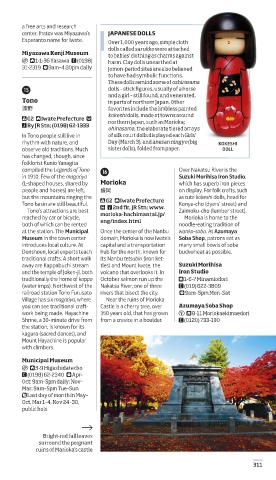
       Esperanto name for Iwate.  Over 1,000 years ago, simple cloth
                             dolls called sarukko were attached
       Miyazawa Kenji Museum  to babies’ clothing as charms against
       "   ⌂ 1-1-36 Yasawa   § (0198)   harm. Clay dolls unearthed at
       31-2319   # 9am–4:30pm daily   Jomon-period sites are also believed
                             to have had symbolic functions.
                             These dolls remind some of oshirasama
       t                     dolls – stick fig ures, usually of a horse
       Tono                  and a girl – still found, and venerated,
                             in parts of northern Japan. Other
       遠野                    favorites include the limbless painted
                             kokeshi dolls, made at towns around
       ! G2   ⌂ Iwate Prefecture   £
       n By JR Stn; (0198) 62-1333    northern Japan, such as Morioka;
                             ohinasama, the elaborate tiered arrays
       In Tono people still live in   of silk court dolls displayed each Girls’
       rhythm with nature, and   Day (March 3); and anesan ningyo (big   KOKESHI
       observe old traditions. Much   sister dolls), folded from paper.  DOLL
       has changed, though, since
       folklorist Kunio Yanagita
       compiled the Legends of Tono   y        Over Nakatsu River is the
       in 1910. Few of the magariya            Suzuki Morihisa Iron Studio,
       (L-shaped houses, shared by   Morioka   which has superb iron pieces
       people and horses) are left,   盛岡       on display. For folk crafts, such
       but the mountains ringing the   ! G2   ⌂ Iwate Prefecture      as cute kokeshi dolls, head for
       Tono basin are still beautiful.  £   n 2nd flr, JR Stn; www.  Konya-cho (dyers’ street) and
         Tono’s attractions are best   morioka-hachimantai.jp/  Zaimoku-cho (lumber street).
       reached by car or bicycle,                Morioka is home to the
       both of which can be rented    eng/index.html  noodle-eating tradition of
       at the station. The Municipal   Once the center of the Nanbu   wanko-soba. At Azumaya
       Museum in the town center   domain, Morioka is now Iwate’s   Soba Shop, patrons eat as
       introduces local culture. At   capital and a transportation   many small bowls of soba
       Denshoen, local experts teach   hub for the north, known for   buck wheat as possible.
       traditional crafts. A short walk   its Nanbu tetsubin (iron ket-
       away are Kappabuchi stream   tles) and Mount Iwate, the   Suzuki Morihisa
       and the tem ple of Joken-ji, both  volcano that over looks it. In   Iron Studio
       tradi tionally the home of kappa   October salmon run up the   ⌂ 1-6-7 Minamiodori
       (water imps). North west of the   Nakatsu River, one of three   § (019) 622-3809
       railroad station Tono Furusato   rivers that bisect the city.   # 9am–5pm Mon–Sat
       Village has six magariya, where     Near the ruins of Morioka
       you can see traditional craft-  Castle is a cherry tree, over   Azumaya Soba Shop
       work being made. Hayachine   350 years old, that has grown   \   ⌂ 8-11 Moriokaekimaedori
       Shrine, a 30-minute drive from  from a crevice in a boulder.  § (0120) 733-130
       the station, is known for its
       kagura (sacred dances), and
       Mount Hayachine is popular
       with climbers.
       Municipal Museum
       "   ⌂ 3-9 Higashidatecho
       § (0198) 62-2340   # Apr–
       Oct: 9am–5pm daily; Nov–
       Mar: 9am–5pm Tue–Sun
       ¢ Last day of month in May–
       Oct, Mar 1–4, Nov 24–30,
       public hols


            Bright-red fall leaves
           surround the poignant
          ruins of Marioka’s castle
                                                                  311


   310-311_EW_Japan.indd   311                               19/02/2019   12:00

