


Page 37 - (DK Eyewitness) Travel Guide - Japan
P. 37
WHAT WAS
                                                 METABOLISM?
                                                 Postwar reconstruction
                                                 efforts in Japan’s cities
                                                 spawned new ideas
                                                 about the future of
                                                 urban planning and
                                                 design. One of the most
                                                 important of these was
                                                 Metabolism. This
                                                 movement came about
                                                 during preparation for
                                                 the 1960 Tokyo World
                                                 Design Conference,
                                                 embraced the idea of
                                                 modern cities in flux –
                                                 constantly changing
                                                 and adapting to meet
                                                 the needs of their
                                                 residents. This called
                                                 for modular megastruc-
                                                 tures that could grow
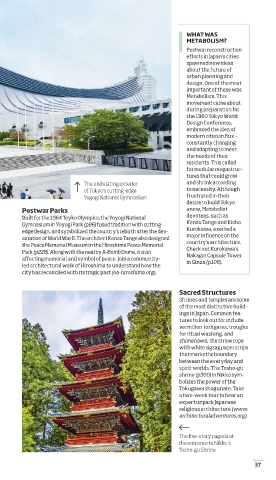
                       The undulating exterior    and shrink according
                       of Tokyo’s cutting-edge   to necessity. Although
                       Yogogi National Gymnasium  frustrated in their
                                                 desire to build Tokyo
       Postwar Parks                             anew, Metabolist
       Built for the 1964 Toyko Olympics, the Yoyogi National   devotees, such as
       Gymnasium in Yoyogi Park (p96) fused tradition with cutting-  Kenzo Tange and Kisho
       edge design, and symbolized the country’s rebirth after the dev -  Kurokawa, exerted a
       as tation of World War II. The architect Kenzo Tange also designed   major influence on the
       the Peace Memorial Museum in the Hiroshima Peace Memorial   country’s architecture.
       Park (p228). Along with the nearby A-Bomb Dome, it is an   Check out Kurokawa’s
       affecting memorial and symbol of peace. Join a community-   Nakagin Capsule Tower

                                                 in Ginza (p106).
       led architec tural walk of Hiroshima to understand how the
       city has reconciled with its tragic past (oa-hiroshima.org).
                                               Sacred Structures
                                               Shrines and temples are some
                                               of the most distinctive build-
                                               ings in Japan. Common fea-
                                               tures to look out for include
                                               vermil ion torii gates, troughs
                                               for ritual washing, and
                                               shimenawa, the straw rope
                                               with white zigzag paper strips
                                               that marks the boundary
                                               between the everyday and
                                               spirit worlds. The Tosho-gu
                                               shrine (p300) in Nikko sym-
                                               bolizes the power of the
                                               Tokugawa shogunate. Take
                                               a two-week tour to hear an
                                               expert unpack Japanese
                                               religious architec ture (www.
                                               architecturaladventures.org).

                                               The five-story pagoda at
                                               the entrance to Nikko ‘s
                                               Tosho-gu Shrine

                                                                  37


   036-037_EW_Japan.indd   37                                04/02/2019   15:56

