


Page 73 - (DK Eyewitness) Travel Guide - Japan
P. 73
2


                                  3                             4

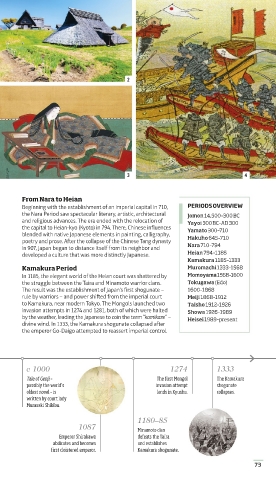
       From Nara to Heian
       Beginning with the establishment of an imperial capital in 710,   PERIODS OVERVIEW
       the Nara Period saw spectacular literary, artistic, architectural   Jomon 14,500–300 BC
       and religious advances. The era ended with the relocation of   Yayoi 300 BC–AD 300
       the capital to Heian-kyo (Kyoto) in 794. There, Chinese influences   Yamato 300–710
       blended with native Japanese elements in painting, calligraphy,   Hakuho 645–710
       poetry and prose. After the collapse of the Chinese Tang dynasty
       in 907, Japan began to distance itself from its neighbor and   Nara 710–794
       developed a culture that was more distinctly Japanese.   Heian 794–1185
                                                 Kamakura 1185–1333
       Kamakura Period                           Muromachi 1333–1568
       In 1185, the elegant world of the Heian court was shattered by   Momoyama 1568–1600
       the struggle between the Taira and Minamoto warrior clans.   Tokugawa (Edo)
       The result was the establishment of Japan’s first shogunate –   1600–1868
       rule by warriors – and power shifted from the imperial court     Meiji 1868–1912
       to Kamakura, near modern Tokyo. The Mongols launched two   Taisho 1912–1926
       invasion attempts in 1274 and 1281, both of which were halted   Showa 1926–1989
       by the weather, leading the Japanese to coin the term “kamikaze” –     Heisei 1989–present
       divine wind. In 1333, the Kamakura shogunate collapsed after
       the emperor Go-Daigo attempted to reassert imperial control.


        c 1000                               1274        1333
        Tale of Genji –                  The first Mongol   The Kamakura
        possibly the world’s             invasion attempt   shogunate
        oldest novel – is                lands in Kyushu.   collapses.
        written by court lady
        Murasaki Shikibu.

                                    1180–85
                     1087           Minamoto clan
                Emperor Shirakawa   defeats the Taira
               abdicates and becomes   and establishes
              first cloistered emperor.  Kamakura shogunate.
                                                                  73


   072-077_EW_Japan.indd   73                                19/02/2019   12:00

