


Page 75 - (DK Eyewitness) Travel Guide - Japan
P. 75
4

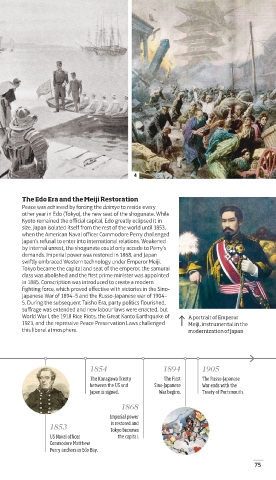
       The Edo Era and the Meiji Restoration
       Peace was achieved by forcing the daimyo to reside every
       other year in Edo (Tokyo), the new seat of the shogunate. While
       Kyoto remained the official capital, Edo greatly eclipsed it in
       size. Japan isolated itself from the rest of the world until 1853,
       when the American Naval officer Commodore Perry challenged
       Japan’s refusal to enter into international relations. Weakened
       by internal unrest, the shogunate could only accede to Perry’s
       demands. Imperial power was restored in 1868, and Japan
       swiftly embraced Western technology under Emperor Meiji.
       Tokyo became the capital and seat of the emperor, the samurai
       class was abolished and the first prime minister was appointed
       in 1885. Conscription was introduced to create a modern
       fighting force, which proved effective with victories in the Sino-
       Japanese War of 1894–5 and the Russo-Japanese war of 1904–
       5. During the subsequent Taisho Era, party politics flourished,
       suffrage was extended and new labour laws were enacted, but
       World War I, the 1918 Rice Riots, the Great Kanto Earthquake of   A portrait of Emperor
       1923, and the repressive Peace Preservation Laws challenged   Meiji, instrumental in the
       this liberal atmosphere.                  modernization of Japan


                        1854               1894      1905
                        The Kanagawa Treaty   The First    The Russo-Japanese
                        between the US and   Sino-Japanese    War ends with the
                        Japan is signed.  War begins.  Treaty of Portsmouth.
                                1868
                             Imperial power
                              is restored and
              1853           Tokyo becomes
              US Naval officer   the capital.
              Commodore Matthew
              Perry anchors in Edo Bay.
                                                                  75


   072-077_EW_Japan.indd   75                                04/02/2019   15:57

