


Page 83 - (DK Eyewitness) Travel Guide - Japan
P. 83
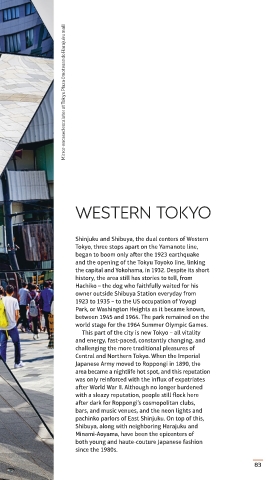
Mirror-encased escalator at Tokyu Plaza Omotesando Harajuku mall


                    WESTERN TOKYO


                    Shinjuku and Shibuya, the dual centers of Western
                    Tokyo, three stops apart on the Yamanote line,
                    began to boom only after the 1923 earthquake
                    and the opening of the Tokyu Toyoko line, linking
                    the capital and Yokohama, in 1932. Despite its short
                    history, the area still has stories to tell, from
                    Hachiko – the dog who faithfully waited for his
                    owner outside Shibuya Station everyday from
                    1923 to 1935 – to the US occupation of Yoyogi
                    Park, or Washington Heights as it became known,
                    between 1945 and 1964. The park remained on the
                    world stage for the 1964 Summer Olympic Games.
                      This part of the city is new Tokyo – all vitality
                    and energy, fast-paced, constantly changing, and
                    challenging the more traditional pleasures of
                    Central and Northern Tokyo. When the Imperial
                    Japanese Army moved to Roppongi in 1890, the
                    area became a nightlife hot spot, and this reputation
                    was only reinforced with the influx of expatriates
                    after World War II. Although no longer burdened
                    with a sleazy reputation, people still flock here
                    after dark for Rop pongi’s cosmopolitan clubs,
                    bars, and music venues, and the neon lights and
                    pachinko par lors of East Shinjuku. On top of this,
                    Shibuya, along with neighboring Harajuku and
                    Minami-Aoyama, have been the epicenters of
                    both young and haute-couture Japanese fashion
                    since the 1980s.
                                                                  83


   082-083_EW_Japan.indd   83                                04/02/2019   14:54

