


Page 86 - (DK Eyewitness) Travel Guide - Japan
P. 86
1 "
MEIJI SHRINE
明治神宮
B7 ⌂ 1-1 Yoyogikamizonocho £ Harajuku Stn,
EXPERIENCE Western Tokyo For Tokyo’s residents, the lush 170-acre (69-ha) THE MEIJI EMPEROR
Yamanote line # Treasure Museum and Annex: Closed
for renovation; Nai-en garden: dawn–dusk daily (times
vary seasonally) ∑ meijijingu.or.jp/english
grounds of the Meiji Shrine (Meiji Jingū) are a welcome
Having succeeded to
green lung in the heart of this hectic city. As the capital’s
the throne in 1868 at
most important Shinto shrine, it offers visitors a
just 14 years of age,
tantalizing glimpse of an older Japan. Take a stroll
the Meiji Emperor set
through its beautiful grounds, stocked with some
During his reign, the
120,000 trees, learn more about the imperial family
Diet was founded, the
through the artifacts on display in the museums, out to modernize Japan.
industrial revolution
and soak up traditional temple life. took place, and the
country emerged
Originally built in 1920, the Meiji Shrine was victorious from con
destroyed during the Tokyo air raids, but flicts with China, Korea,
was rebuilt in 1958. Controversially, the shrine and Russia.
was rededicated to Emperor Meiji (1852–1912),
rather than a kami (spirit), contravening the
imperial family’s renunciation of divinity
following World War II. At the Treasure Museum
and its annexe, visitors can see items belonging
to the imperial family, including gorgeous
kimonos, lacquer ware, and furniture. Don’t miss
the Nai-en garden, said to have been designed
by the emperor for his wife. Here, a teahouse
over looks a pond stocked with water lilies and
carp. To the right of the pond, a path leads to
the beautiful Minami-ike Shobuda (iris garden),
which contains over 150 species.
Guiding Spirit
One of the most striking sights at the Meiji
Shrine is the huge wall of sake barrels. While
the barrels on display are empty, they are
loaded with meaning. Sake is supposed to
facilitate the connection with the gods and in
the oldest Japanese texts “miki,” the old word
for sake, is written with the characters for “god”
and “wine.” Shinto shrines pray for the brewers’
prosperity and, in turn, the breweries donate
sake for the shrines’ rituals and ceremonies.
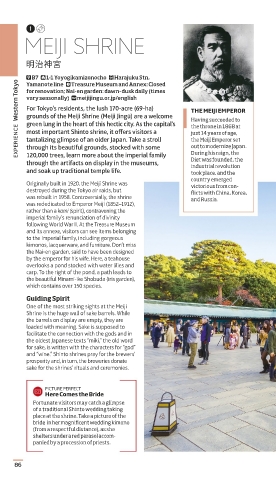
PICTURE PERFECT
Here Comes the Bride
Fortunate visitors may catch a glimpse
of a traditional Shinto wedding taking
place at the shrine. Take a picture of the
bride in her magnificent wedding kimono
(from a respectful distance), as she
shelters under a red parasol accom
panied by a procession of priests.
86
086-087_EW_Japan.indd 86 04/02/2019 14:54
EW Must-see template v2.1 – 18th October 2018
Fonts: Aptifer Sans LT Pro, Posterama Text, Soho Gothic
Pro, Soho Pro, ITC Caslon 224

