


Page 98 - Esquire - USA (Winter 2020)
P. 98
one day in September 2013 in Agadez,
        Niger,  an  ancient  market  town  in  the
        middle of the Sahara, eight cops stormed a
        mud-brick home searching for a terrorist.
        There’d been reports of a white man with a
        bushy beard coming and going on a stolen
        motorcycle—an  unusual  sight  made
        stranger by the color of his bike: purple.
          “Get up! Get up!” the cops shouted as
        they rustled awake the several men sleep-
        ing on the floor. They found not one but
        two white men, whom they took away for
        questioning.
          At  the  police  station,  Christopher
        Kirkley, a pensive, close-cropped, thirty-
        three-year-old  from  Portland,  Oregon,
        explained that he and his bearded friend
        weren’t terrorists at all. “We’re making a
        movie!” he said in broken French. It was
        the first one ever shot not only in Agadez
        but  in  the  language  of  the  Tuareg,  the
        seminomadic people who’d roamed the
        region for centuries. The star of the film
        was one of the men asleep in the mud-
        brick  home:  Mahamadou  Souleymane,
        aka Mdou Moctar, a lanky, twenty-nine-
        year-old, explosively gifted left-handed
        Tuareg  guitarist  who  shredded  like  a
        Saharan Hendrix. And the purple motor-
        cycle wasn’t stolen. They had rented and
        painted it to be the main prop. The men
        were  released  after  Kirkley  explained
        what the film was about. “It’s an homage
        to Purple Rain,” he told the cops.


        MDOU  MOCTAR  WAS  never  meant  to  play
        guitar. While he was growing up in Arlit,
        Niger, a uranium-mining desert town, his
        strict Muslim parents, Souleymane and
        Fatima, considered guitars instruments
        of evil for booze, hash, and
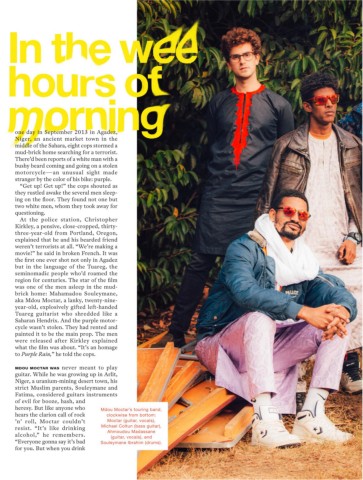
        heresy. But like anyone who           Mdou Moctar’s touring band,
        hears the clarion call of rock           clockwise from bottom:
        ’n’  roll,  Moctar  couldn’t             Moctar (guitar, vocals),
        resist.  “It’s  like  drinking        Michael Coltun (bass guitar),
                                                 Ahmoudou Madassane
        alcohol,”  he  remembers.
                                                  (guitar, vocals), and
        “Everyone gonna say it’s bad          Souleymane Ibrahim (drums).
        for you. But when you drink

